
What Is Controllable Protein Sequence Design?
Published on October 25, 2026
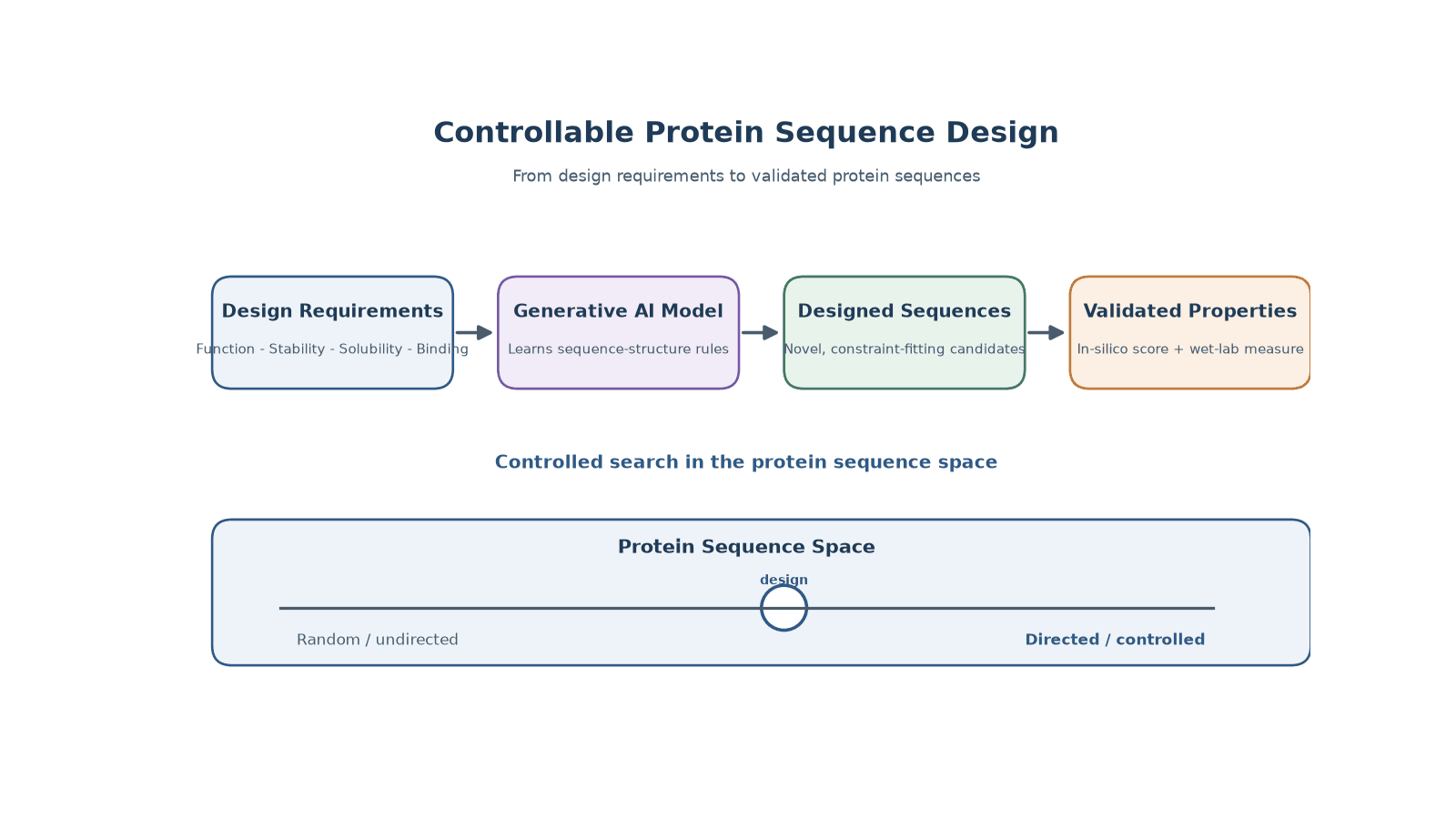
Figure 1. Controllable protein sequence design: concept overview and key flow
Controllable Protein Sequence Design: How AI Generates Protein Sequences on Demand
Proteins are the molecular machines of life, and their function is determined by their amino-acid sequence. Traditionally we find a suitable sequence through natural discovery or directed evolution; controllable protein sequence design hands the initiative to the algorithm — given a target, the AI designs a brand-new sequence that satisfies the conditions. This is not science fiction but a protein-engineering paradigm now landing in industry.
Background and Mechanism: Why Do Protein Sequences Need Controllable Design?
Natural protein sequences are shaped by evolution, and attributes such as activity, stability, and solubility often trade off against one another; controllable protein sequence design turns finding a sequence into designing a sequence, letting researchers tune protein properties toward an objective function.
· Bottleneck: Natural screening and directed evolution rely on mutation plus screening, taking months to years and often getting stuck in local optima.
· Challenge: A sequence is a one-dimensional string, but function depends on three-dimensional folding; the sequence-structure-function mapping is complex, and a single mutation can have far-reaching effects.
· Trade-off: Higher activity, more thermostable, more soluble, and better specificity are frequent trade-offs.
· Controllable design: Turn requirements into constraints or objectives and let AI search the huge sequence space in a directed way instead of blind mutation.
The size of sequence space is staggering: a 100-residue protein could theoretically combine into 20 to the power of 100 sequences, far beyond what any experiment can cover. That is why blind random mutation is inefficient, while controllable design focuses computation on the regions that matter.
· Leveraging biochemical knowledge: Using existing mutation, structure, and function data as priors can significantly improve design success.
Analogy: just as a large language model can write a coherent paragraph given a topic and style constraint, a protein design model can generate a plausible sequence given a structure or property constraint.
Seen this way, the essence of controllable protein sequence design is to accelerate evolution and to front-load the design intent into the algorithm.
Principle and Structure: How Does Controllable Protein Sequence Design Work?
Controllable protein sequence design is built on generative model plus conditional control: the model first learns the sequence-structure rules of many real proteins, then decodes new constraint-satisfying sequences conditioned on a structure template, property target, or evolutionary signal.
· Generative model: Protein language/folding models based on Transformers, graph neural networks, or diffusion, which learn the joint sequence-structure distribution.
Three paths of conditional control:
· 1) Structure condition: Given a backbone, design a sequence that folds into that structure (inverse folding).
· 2) Property condition: Guide generation with activity, stability, or solubility targets (guidance/reward) toward higher fitness.
· 3) Evolutionary condition: Model conserved sites and residue co-evolution via MSA or homologous sequences, preserving natural evolutionary information.
· Fitness landscape: Map protein properties onto hills and valleys, letting the model search for higher peaks.
· Capability boundary: Generation does not equal correctness; generalization to unseen protein families is limited and must be verified experimentally.
A generative model's output is not creation from nothing: it can do inverse folding from an existing protein structure, or conditional sampling over multi-sequence homologous information. The difference lies in constraint strength — the stronger the structure constraint, the more focused the generation; the more property targets, the more multi-objective trade-off is needed.
· Active learning: Each round of experimental data feeds back, flagging which sequences are closer to the target, so the model concentrates the next round on high-information regions, reducing wasted attempts.

Figure 2. How conditional control guides the model to generate a target sequence
Assay and Selection: How Do You Evaluate a Designed Sequence?
Whether a designed sequence is usable is measured with two rulers, predictable plus measurable: first coarse-filter with computational scores (structure feasibility, energy, physicochemical properties), then measure activity, stability, expression, and specificity in the wet lab.
· Computational (in silico, predicted): Structure confidence (e.g., pLDDT), Rosetta energy/ddG, solubility and aggregation scores, developability.
· Experimental (wet, measured): Expression level, solubility, thermal stability (Tm), activity/catalytic efficiency, binding affinity (KD), specificity.
Always distinguish predicted from measured: computational scores merely screen candidates; only wet-lab data can support a conclusion.
· Selection by use case: Industrial enzyme catalysis favors activity/stability; antibodies favor affinity/developability; industrial proteins favor robustness and manufacturability.
A fuller evaluation often follows a funnel: first coarse computational screening, then high-expression/solubility pre-screening, then functional assays, and finally stability and developability validation; later tests are costlier but more informative, so budget is best spent there.
· Data transparency: Recording the gap between predicted and measured is both a way to evaluate the model and an input to the next iteration.
Conditions and Process: What Key Parameters Take You from Design to a Verifiable Candidate?
Getting from design to a verifiable candidate hinges on the dry-wet closed loop: the design-build-test-learn (DBTL) cycle iterates repeatedly, and each step demands clear feasibility and reproducible parameters that align computational plans with experimental feedback.
DBTL loop: Define Target, Generate Sequences, Screen in silico, Test in wet lab, Learn, iterate.
· Candidate pool size: How many sequences to generate/screen per batch; too large wastes wet-lab budget, too small under-covers.
· Screening threshold: Which computational scores must pass before entering the wet lab, so budget isn't spent on low-potential sequences.
· Expression & purification system: Host, vector, and purification must be standardized to compare designs fairly.
· Reproducibility: The same design should repeat a similar result; otherwise the model's effect cannot be judged.
Cost and cycle time: focus limited wet-lab effort on the highest-potential candidates, reducing blind trial and error.
· Data feedback: Feed wet-lab measured values back into training/fine-tuning so the model gradually aligns with the real system.
· Quality control: Set controls and replicates in expression, purification, and assays to avoid mistaking systematic error for sequence differences.
· Iteration rounds & budget: Plan the number of design-verify rounds and investment against risk and timeline, avoiding an endless loop.
A mature dry-wet closed loop usually needs several iterations: the first design validates the path, later rounds focus on optimization, and with more data the model gets more accurate.

Figure 3. Design-build-test-learn (DBTL) closed-loop pipeline
How Does MatwingsVenus®(晓鹜®) Participate?
MatwingsVenus®(晓鹜®) links generative design with experimental feedback into a dry-wet closed loop, making controllable protein sequence design not just an algorithm but a deliverable path that lands in the wet lab.
· Design (dry): VenusREM single-point scanning, VenusPrime multi-point epistatic modeling, VenusX/VenusG functional-residue and property prediction.
· Wet-lab collaboration: Recommend high-potential sites/combinations for wet-lab verification; measured data feed back to update the model.
· Dry-wet closed-loop platform: Forms a loop between computational suggestions and experimental data, continuously improving design accuracy.
· Use cases: Protein engineering, enzyme engineering, antibody design, industrial proteins.
· Data & traceability: Keep the design rationale, predicted scores, and experimental conclusions on record for review and reuse.
For example, for an industrial enzyme needing higher thermal stability, the platform can first run single-point and combination scanning on the structure, then use VenusX/VenusG to predict stability and expression tendency, handing a few dozen most worthwhile candidates to the wet lab; once measured data returns, the model updates and enters the next round, gradually approaching the target.
Related products & services:
· Wet lab: Products and services for the wet-lab stage (link: /zh/products/wet-lab).
· Selection consultation: Expert center and selection consultation (link: /zh/products/expert-center).
· Closed-loop platform: Dry-wet closed-loop platform (link: /zh/dry-wet-closed-loop-platform).
Get selection advice / submit a sample / request a quote. Contact: +86 13061973951, info@matwings.com.
Frequently Asked Questions (FAQ)
What is the difference between controllable protein sequence design and traditional directed evolution?
Controllable protein sequence design uses a generative model to produce many candidates under constraints in a directed way, while directed evolution approaches a goal through random mutation and screening step by step; the former covers a much larger sequence space more quickly.
Will a generated sequence always express successfully in the lab?
Not necessarily. A computationally generated sequence may fail to fold or express, so it must be coarse-filtered in silico and validated in the wet lab before it can be confirmed usable.
Can controllable protein sequence design improve thermal stability?
Yes. Adding thermal stability as a constraint or target usually increases heat resistance, but Tm and related metrics still need to be measured in the lab to confirm.
What proteins does this technique apply to?
It applies to enzymes, antibodies, and industrial proteins, but model generalization is affected by training-data coverage, and performance on unfamiliar families is limited.
What inputs are needed to use this technique?
Typically the target protein's sequence, structure (PDB or AlphaFold model), or key property targets; the clearer the input, the more focused the design.
Do AI-generated sequences pose safety risks?
Model outputs must undergo manual safety review to avoid introducing toxicity, pathogenicity, or regulatory-sensitive sequences, a boundary controllable design must respect.
How do I start with MatwingsVenus®(晓鹜®)?
Submit your requirement or sample to get a design/screening plan, then validate and iterate with the platform and the wet lab to form a candidate deliverable.
Conclusion
Controllable protein sequence design is turning protein engineering from trial and error into design by plan. Its value is not to replace experiments but to make every wet-lab round spend on candidates more likely to succeed. As data and models keep accumulating, this design-validate-learn loop will get more accurate and faster.
Explore MatwingsVenus®(晓鹜®), More News
· Platform: Learn about the MatwingsVenus®(晓鹜®) dry-wet closed-loop platform and protein tools (link: /zh/dry-wet-closed-loop-platform).
· More news: Read more news on protein engineering, AI protein design, and industry applications.