
Directed Evolution Positive Mutant Screening: From Variant Libraries to Validated Hits
Published on October 20, 2026
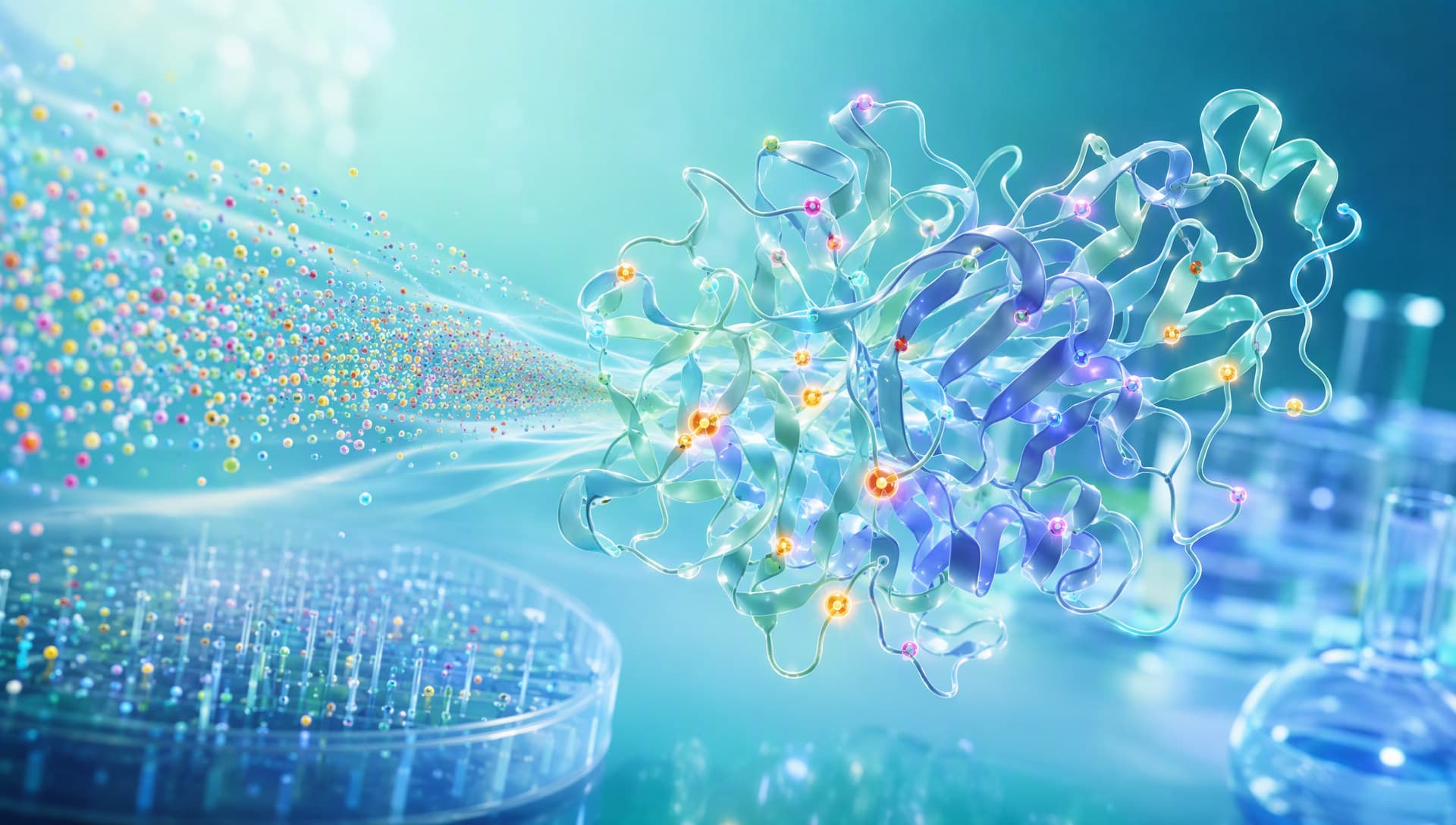
Directed evolution resembles searching a vast sequence landscape for rare, valuable signals. Mutagenesis creates diversity quickly, but project speed ultimately depends on whether the assay reflects the intended phenotype and whether limited experimental capacity is focused on informative candidates. For activity, stability, affinity, or expression goals, directed evolution positive mutant screening works best as an evidence-led narrowing process in which computation, experiments, and data feedback improve each subsequent decision.
Directed Evolution Positive Mutant Screening Needs a Reliable Signal
Directed evolution combines diversity generation with identification of desired variants. Random mutagenesis, recombination, and semi-rational design can produce large libraries, but a larger library does not automatically produce better outcomes. If an assay is disconnected from the real application or experimental noise exceeds differences among candidates, higher throughput may simply generate low-value data faster.
Screening and selection also solve different problems. Screening measures candidates individually, often producing richer quantitative data. Selection uses pressure to remove nonfunctional variants and can compress a library rapidly when survival or enrichment can be linked to the target property. In both cases, directed evolution positive mutant screening should begin with three questions: Is the optimization target measurable? Does the readout match the intended use? Can the resulting data guide the next round?
Intelligent R&D Workflow: Protect Critical Sites Before Narrowing the Search Space
An efficient workflow does not begin with blind enumeration. It first establishes a wild-type baseline, retrieves prior variant and functional evidence, and identifies residues associated with catalysis, binding, or structural integrity. Treating these residues as protected regions reduces obviously damaging designs and reserves experimental resources for more plausible candidates.
An intelligent protein R&D agent can organize the objective, sequence, structure, and available assay data into one task. It can map functional sites, estimate how single substitutions may affect activity, binding, stability, or expression, and return a ranked list with evidence labels. These outputs prioritize experiments; they do not turn predictions into measured facts. Candidates still require wet-lab confirmation with an assay matched to the target phenotype.

Critical residues are protected while layered evidence reduces the library
A Strong Single Mutation May Fail in Combination
A substitution that performs well alone may behave differently when combined with another substitution. Epistasis, structural strain, local interactions, or expression burden can alter the final phenotype. Directed evolution positive mutant screening therefore cannot rely on adding single-mutation scores; it must evaluate combinations within a tractable set of positions.
Combination modeling turns “all possible combinations” into “combinations worth synthesizing.” When wet-lab data are available, the agent can support training and inference workflows that update candidate priorities. When evidence is sparse, measured observations must remain distinct from predictions, and experiments should be chosen for information gain as well as expected performance. This avoids committing to an expensive full library while preserving traceable inputs for later learning.
Feed Experimental Results Back into the Next Round
Conventional projects often summarize results only after a screening campaign ends, and failed variants may disappear from the record. Yet both positive and negative results help define the feasible sequence landscape. An active-learning workflow uses measurements from the previous round to select candidates that balance high expected performance with high information value.
Once the wild type, optimization objective, and data format are clear, an agent can orchestrate a loop of candidate proposal, human approval, experimental testing, result ingestion, and redesign. Human approval before compute-intensive steps lets researchers verify inputs, positions, and expected outputs. Directed evolution positive mutant screening then becomes an accumulating learning process rather than a one-off ranking exercise.

Experimental feedback drives the next cycle of candidate design
A Practical Five-Step Screening Workflow
Define One Quantifiable Objective
Choose a primary objective and explicit constraints—for example, improve thermal stability while retaining activity. Set the assay window, replicate strategy, and positive threshold before library construction.
Establish a Baseline and Protected Regions
Collect the wild-type sequence, available structure, known functional residues, and existing measurements. Protect catalytic or binding residues unless there is a specific hypothesis for changing them.
Generate Candidates in Layers
Use single-mutation scanning to identify potentially beneficial and high-risk positions, then model combinations among a small number of priority sites. An intelligent research platform can keep inputs, prediction labels, ranked candidates, and validation recommendations in one traceable workflow.
Calibrate Rankings with a Small Experimental Batch
Test candidates that cover different mechanistic hypotheses rather than selecting only a cluster of highly similar top scores. Preserve raw measurements, replicates, and failed outcomes so the next model update receives credible evidence.
Return Results to Design
Normalize measured outputs and feed them into active learning for the next selection round. Efficiency in directed evolution positive mutant screening usually comes from repeated, information-rich iterations—not from promising that one prediction will deliver the final product.
FAQ
Is a larger mutant library always better?
No. Library size must match assay throughput, sensitivity, and the target phenotype. A smaller focused library with a clear design rationale can be more informative than a very large random library.
Can computational ranking replace wet-lab testing?
No. Computation can reduce the candidate space, flag risks, and improve experimental order, but activity, stability, affinity, and expression claims still require measurements in a relevant assay.
Can a project start without a large historical dataset?
Yes. Prior evidence, protected-site mapping, and single-mutation scanning can guide a small first experimental batch. Those results can seed combination modeling and active learning. Data quality is often more valuable than raw volume.
Conclusion: Turn Screening into a Learning Engine
The purpose of directed evolution positive mutant screening is not to manufacture the largest possible candidate list. It is to increase the decision value of every experiment. Functional-site protection, single-mutation scanning, combination modeling, experimental feedback, and active learning can connect fragmented steps into a traceable decision chain. For teams seeking fewer unproductive syntheses, shorter trial-and-error cycles, and reusable sequence–function knowledge, a human-guided computational and experimental loop offers a practical route to the next validated candidate set.