
Combinatorial Mutagenesis Library Design Methods: From Sites to Screening
Published on October 19, 2026
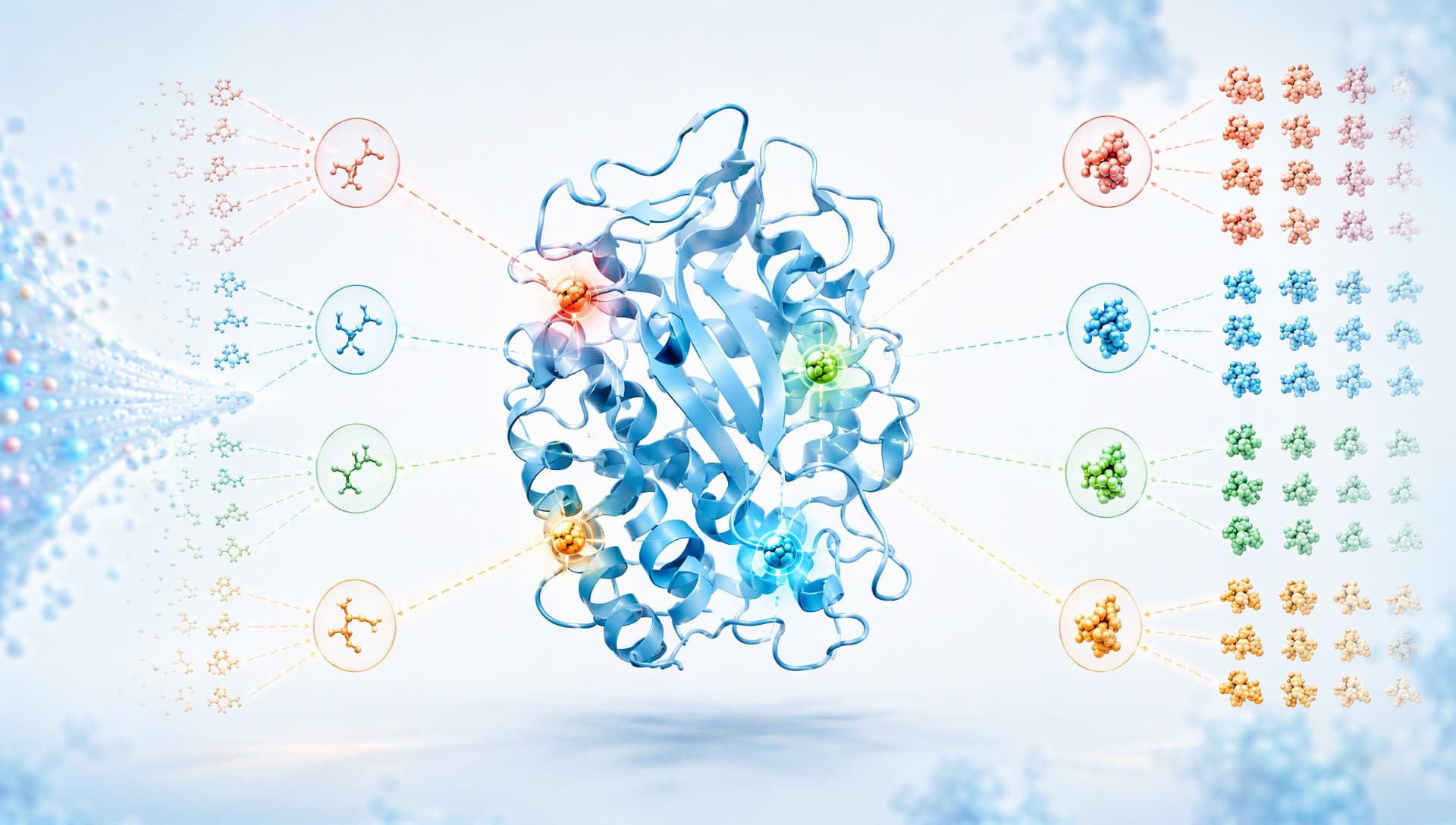
Focused sites turn a vast mutation space into testable choices
Category: Protein Engineering / Directed Evolution / Synthetic Biology
The purpose of a combinatorial library is not simply to create more sequences. It is to spend limited synthesis, transformation, and screening capacity on variants that carry more useful information. Effective combinatorial mutagenesis library design methods connect four decisions from the start: the property to optimize, the residues to vary, the amino acids allowed at each residue, and the number of variants the assay can reliably evaluate. When computational prioritization, construction constraints, and experimental readouts are designed as one system, library size becomes manageable and positive hits are easier to interpret and reproduce.
Let screening capacity set the library boundary
A common workflow selects several hotspots first and calculates the resulting library afterward. A more robust workflow reverses that sequence. Define the practical screening ceiling, assay dynamic range, and confirmation burden first; then calculate the sequence space the project can afford to explore.
Four sites with 20 amino-acid choices each create 20⁴, or 160,000, theoretical combinations. Six such sites create 64 million. Real libraries are further shaped by codon bias, cloning efficiency, transformation efficiency, and uneven variant abundance. A sequence that exists on paper is not necessarily represented at a useful frequency in the experiment.
Set four resource limits before finalizing the design:
• Screenable clone count: the number that can actually be expressed, measured, and confirmed—not the instrument’s nominal throughput;
• Coverage objective: exhaustive coverage, statistical sampling, or a focused search for high-value candidates;
• Confirmation cost: the capacity for replicate assays, sequencing, and orthogonal validation;
• Error preference: whether missing a weak positive or accepting a false positive is more damaging.
These limits determine whether a project should use a full combinatorial design or a compact, staged strategy. When screening capacity is constrained, reducing the amino-acid alphabet, splitting residue groups, or using iterative rounds is usually more productive than opening every combination at once.
How MatwingsVenus®(protein agent)supports combinatorial mutagenesis library design methods
Residues should be prioritized by their relationship to the target phenotype, not only by distance from an active site. Candidate positions can be separated into direct catalytic or binding residues, second-shell positions that shape local geometry and access channels, and distal positions that may influence stability, expression, or conformational dynamics.
A practical evidence stack includes:
1. Experimentally measured variants in curated databases and publications;
2. Conserved and variable patterns from multiple-sequence alignments;
3. Pockets, interfaces, channels, and contact networks in three-dimensional structures;
4. Gain- and loss-of-function signals from single-mutant scans or internal experiments;
5. Positions supported by more than one evidence type but not yet fully validated.
Within the protein-engineering workflow of MatwingsVenus®(晓鹜®), teams can retrieve prior evidence, map functional residues with VenusX, and establish protected “do-not-disturb” regions before using VenusREM to assess single-mutation effects. These outputs are predictions. They can prioritize experiments and narrow the search space, but they do not replace measurements. Their value in library planning is to remove clearly low-value combinations rather than to claim one uniquely correct design.
Amino-acid alphabets control information density
Once positions are selected, the next decision is not automatically to test all 20 amino acids at every site. Full saturation can reveal unexpected solutions, but it also expands library size and may introduce stop codons, synonymous redundancy, and many variants with little probability of success.

Thoughtful amino-acid choices increase information per screened variant
Choose the alphabet at each position by considering:
• Chemical coverage: representative hydrophobic, polar, charged, and aromatic side chains;
• Structural context: conservative options in buried cores and broader polarity or charge changes at exposed sites;
• Evolutionary evidence: residues already observed in compatible natural homologs;
• Optimization goal: activity, selectivity, stability, and expression may require different side-chain changes;
• Encoding strategy: the actual coverage, redundancy, stop-codon risk, and cost of NNK, NDT, or custom mixed-codon schemes.
A high-quality combinatorial library therefore maximizes the value of each tested variant, not randomness itself. Preserve enough chemical diversity when epistasis is plausible. If support for a site is weak, use a smaller alphabet or validate it in a single-site round first.
Group residues around plausible interactions and assay limits
The main advantage of combinatorial mutagenesis is its ability to reveal synergy or antagonism that cannot be inferred by adding single-mutant effects. Putting every candidate site into one library, however, often buries useful signals inside exponential background diversity.
More executable combinatorial mutagenesis library design methods group residues by spatial relationships, functional modules, and experimental capacity. Two to four positions near a substrate channel might form one group, while distal stability-related positions form another. Screen the groups separately, then recombine validated beneficial changes. For projects with a clear iterative path, retain several promising parents after each round before opening the next position group; this reduces the chance of committing too early to a local optimum.
Three principles are particularly useful:
• Spatial neighbors are not automatically synergistic, and distant sites are not automatically independent;
• Retain multiple parents with distinct profiles or overlapping confidence intervals, not only one apparent winner;
• Feed each round’s results back into the next residue set and amino-acid alphabet instead of merely adding mutations.
When sequence–performance data are available, VenusPrime in MatwingsVenus®(晓鹜®) can support multipoint combination modeling. For multi-round directed evolution with the required experimental data file, ALDE can support active-learning decisions. Both are best used to rank candidates and guide experiments, with wet-lab feedback continuously updating the next design round.
Treat the assay as part of library design
You are more likely to obtain what the assay rewards. If the measured signal does not match the final product goal, even a well-constructed library can drive the project in the wrong direction. Catalytic activity, substrate selectivity, thermal stability, expression, and aggregation resistance may require different primary screens and confirmation thresholds.
Before ordering oligonucleotides or genes, lock down positive and negative controls, detection window, replication, batch normalization, hit threshold, confirmation criteria, and sequencing trace-back. If the screen uses a surrogate substrate or indirect reporter, verify its correlation with the intended property. Primary screening should favor throughput; secondary screening should favor quantitative reproducibility. They should not be treated as the same decision layer.

Continuous feedback connects computational prioritization with experimental proof
MatwingsVenus®(晓鹜®) follows a retrieval-first logic and separates measured evidence from predicted output. Curated databases and prior evidence come before functional-site mapping, single-mutant assessment, or multipoint modeling, and predicted conclusions still require wet-lab validation. Applying the same discipline to combinatorial mutagenesis helps teams distinguish what is measured, what is predicted, and what remains unknown rather than treating a model score as an experimental performance claim.
A pre-order checklist for a focused library
Before releasing a synthesis order, confirm that:
• The optimization objective can be measured directly and consistently by the planned assay;
• Every candidate site has sequence, structure, publication, or experimental support;
• Essential functional residues and structural risk zones are protected;
• The amino-acid alphabet at each site serves the objective instead of defaulting to full saturation;
• Theoretical library size, desired coverage, and real screening throughput are compatible;
• The codon scheme does not create unacceptable redundancy or stop-codon burden;
• Multiple-parent retention, confirmation, and next-round rules are defined;
• Every computational prediction has a corresponding experimental validation path.
Conclusion: better libraries use constraints to improve hit quality
Combinatorial mutagenesis library design methods are an engineering trade-off among sequence diversity, evidence quality, and experimental resources. Start with the target phenotype and screening boundary. Use sequence, structure, functional-site knowledge, and single-mutant data to rank positions. Then reduce amino-acid alphabets, group sites thoughtfully, and return each round of experimental data to the next design cycle. The resulting library may not be the largest, but it is more likely to produce interpretable, reproducible candidates that can support continued protein optimization.