
How Does Generative Protein Design Fundamentally Reshape Protein Engineering?
Published on October 25, 2026
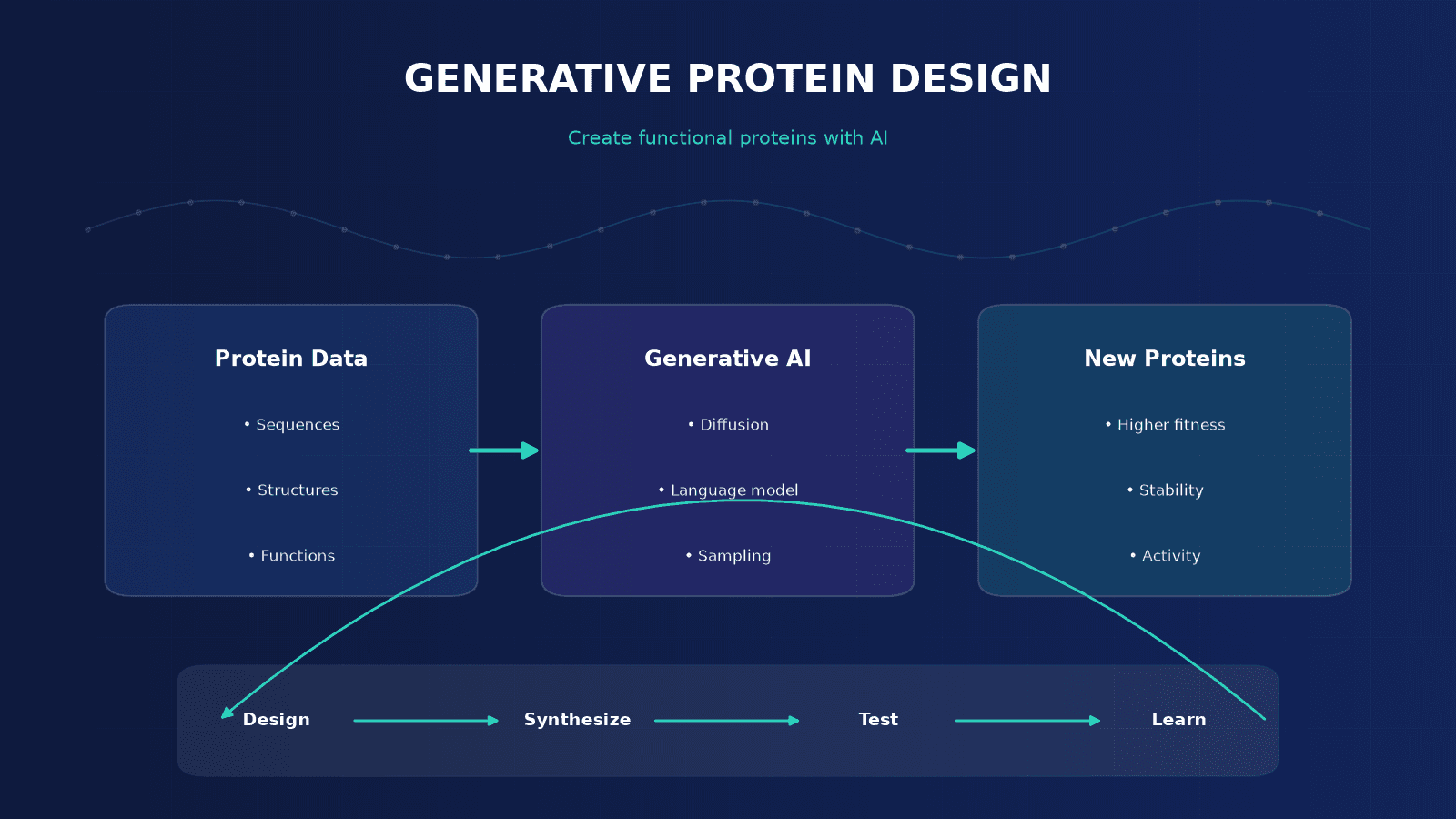
Figure 1. Generative protein design: data → AI → new functional proteins
【Category】
D (AI / Algorithms / Platform); also C (Directed evolution / AI closed loop)
______________________________________________
Conventional protein engineering often relies on "random mutation + large-scale screening": each experimental round can only probe a limited range, at high cost and long lead times. Generative protein design changes that paradigm—it lets the model "learn" the grammar and structural rules of proteins, then "generate" entirely new sequences, directing precious wet-lab effort toward candidates more likely to succeed. For newcomers, it helps to think of the model as a "broad and accurate proposer": having seen thousands of protein sequences, it can propose solutions most people would not think of, while still respecting biological logic. To make the most of it, you should first distinguish "generation" from "screening" and be clear about its limits—it produces candidates, and experiments have the final word.
Background & Mechanism: What Generative Protein Design Is and Why It Matters
Generative protein design treats a protein sequence or structure as a learnable "language" and uses a neural network to generate new candidates; it offers a better starting point than random mutation on targets such as activity, stability, or secretion, thereby cutting experimental rounds and shortening development cycles.
· What "generative" means: Unlike "screening existing mutations," a generative method "creates new options." Common models include protein language models, diffusion models, GANs, and flow models.
· Why it is needed: Very few natural proteins happen to match human needs exactly; desired properties such as heat tolerance, solvent tolerance, or specific substrate specificity are often absent from natural sequences.
· The search space: A protein of 300 amino acids has an almost infinite number of possible sequences; random trial and error is like finding a needle in the ocean. By learning sequence and structure rules, generative models narrow the search to regions more likely to be useful.
· An analogy: Traditional directed evolution is like "navigating an existing map"; generative design is like "directly drawing an optimized new map."
· Applications: enzyme activity and substrate-specificity engineering, antibody affinity improvement, stability and solubility optimization, and de novo binding-protein design all fall within its scope.
· Expected benefit: reach equal or better activity in fewer experimental rounds.
Principle & Structure: How Generative Models "Understand" Proteins and Generate New Sequences
By learning the mapping between amino-acid sequences and spatial structures, generative models turn "design" into intelligent sampling on a fitness landscape: the model proposes candidates, predicts their fitness, then updates itself with measured feedback in an "active learning" loop.

Figure 2. Fitness landscape and active learning: sample, measure, update
· Fitness landscape: maps a protein sequence onto a "terrain" where higher scores mean closer to the target property (activity/stability); peaks are high-fitness regions. The task of a generative model is to climb toward peaks without enumerating the whole landscape.
· Protein language model: like "writing sentences for proteins," it learns the contextual rules of amino acids and can generate plausible, structurally reasonable sequences; well suited to improving within a known family's "grammar."
· Diffusion model: starts from a random "noise" state and gradually "de-noises" into a structured protein; better suited to generating novel scaffolds and more complex functions—a "from nothing" approach.
· How to "direct" generation: constraints can be injected via conditional generation, e.g., a target activity range, solubility, and low immunogenicity; predictors can also score candidates and steer the model toward specific properties.
· Active learning: the candidates where the model is least certain and most informative go to the wet lab first, and the results flow back to update the model, making the next round more accurate. This is what turns "generative" plus "closed loop" into real value.
· Capability boundary (must be stated honestly for category D): the model only produces "candidates." Whether they reach predicted values in the wet lab depends on training data, predictor accuracy, and experimental reproducibility. Current judgments of final function are mostly predictions, and must be confirmed as measured by experiment.
Measurement & Selection: How to Tell Whether Generated Proteins Are Actually Better
The core of evaluating generated proteins is replacing "prediction" with "measurement": first define target metrics (activity, stability, expression, developability), then read out real fitness with standardized wet-lab assays and compare strictly with the parent or a benchmark.
· Define target metrics first: activity (e.g., Km, kcat, IC50, or binding affinity), stability (Tm, half-life), expression (solubility/secretion), and developability (aggregation tendency, immunogenicity). Clearer metrics make it less likely you are swayed by a "good-looking but non-critical" score.
· Standardized assay system: same batch, same conditions, same instrument, to avoid batch-to-batch noise masking real differences; especially important when comparing across generations.
· Throughput vs. quality trade-off: high-throughput primary screening quickly eliminates many candidates but may produce false positives/negatives; high-risk candidates should be confirmed with orthogonal validation (different methods or batches) before conclusions.
· Ranking and selection: rank by measured fitness and prioritize "high-value + high-feasibility" candidates rather than trusting only model scores; a high-scoring but poorly developable candidate may never be usable.
· Be honest about evidence type: model scores are【predicted】, wet-lab results are【measured】; the gap between them is model error and should be reported as such.
Conditions & Workflow: How to Run the Dry-Wet Closed Loop
A reproducible dry-wet closed loop has four steps—design, synthesize, test, learn; each step needs clear inputs, outputs, and quality control, with wet-lab data flowing back into the model to form an iterative process.

Figure 3. Dry-wet closed loop: Design → Synthesize → Test → Learn
· Design: the generative model produces candidate sequences under constraints (target properties, solubility, low immunogenicity), and assesses synthesizability to avoid "designed but not buildable."
· Synthesize: DNA synthesis, cloning, and expression yield measurable protein; robustness here directly affects downstream data reliability.
· Test: wet-lab reads out fitness, with quality control, parallel controls, and replicates to ensure trustworthy data.
· Learn: clean and archive data, update or retrain the model, and start the next round. Data quality ranks above data quantity.
· Key workflow variables: library size, screening throughput, model update frequency, and experimental noise control. These vary greatly by project; determine them from project【measured/estimated】data and use project-specific research values.
· Iteration cadence: this is usually a multi-round "design–synthesize–test–learn" cycle rather than a single shot; review data and model deviations each round and revise targets or constraints if needed.
· Closed-loop value: turns experimentation from "blind trial and error" into "purposeful convergence," clearly lowering the share of uninformative experiments.
MatwingsVenus®(晓鹜®): An AI-Generation × Wet-Lab-Feedback Closed Loop
MatwingsVenus®(晓鹜®)fuses "AI generation" with "wet-lab feedback" into one closed loop: for your target or enzyme, it first clarifies target metrics and assesses data readiness, then generates candidates with generative models, links predictive evaluation to high-throughput wet-lab validation, and feeds experimental data back into the model to form an iterative workflow. In this way, generative design does not stop at "it can generate" but moves toward "usable and reusable."
· Related services (deep-link module)
· Wet-lab platform: high-throughput validation of generated candidates.
· Expert center: project collaboration from goal definition and metric setting to selection strategy.
· Dry-wet closed-loop platform: connects design and experimental data into an iterative closed loop.
Need generative design for your target or enzyme? Contact MatwingsVenus®(晓鹜®)for selection advice or to submit a sample: phone 13061973951, email info@matwings.com.
Frequently Asked Questions (FAQ)
How is generative protein design different from traditional site-directed mutagenesis or directed evolution?
Traditional methods rely mostly on "known mutations + screening," with limited exploration; generative methods actively create new sequences or scaffolds, covering a larger search space with better starting points—but still require wet-lab validation.
Will a protein generated by design definitely work?
Not necessarily. The model provides【predicted】candidates; whether they meet targets depends on the model, predictor, and experimental conditions. They must be confirmed by wet-lab【measured】results and compared with the parent or a benchmark, not judged by model scores alone.
How much data is needed to train a generative model?
It depends on model type and task. Richer, more relevant sequence and structure data usually improve results; the appropriate dataset size versus public baselines must be assessed per project.【To be verified: training-data scale for a given task and public model baselines.】
What is the relationship between generative design and structure prediction like AlphaFold?
AlphaFold predicts the structure of a given sequence; generative design creates new sequences with target functions. They are often combined: generate candidates → predict/assess structure → validate in the wet lab.
How should I choose between a protein language model and a diffusion model?
Protein language models excel at sequence-level improvement within a known family with high plausibility; diffusion models excel at generating novel scaffolds and complex functions. In practice they are often combined, weighing task goals and data by【measured/project experience】.
What practical benefits does the dry-wet closed loop deliver?
It shifts experiments from blind trial and error to purposeful convergence, cutting uninformative rounds and improving success rate and R&D efficiency; quantitative benefits must be assessed with project-specific measured data and should not be generalized.
Is generative design suitable for small teams or non-expert users?
Platform-based services can lower the barrier, handing data, models, and experimental handoff to specialists; the key is to define the project with clear target metrics and quality control rather than chasing complex models.
Conclusion
Generative protein design shifts protein engineering from heavy random screening toward intelligent sampling on a fitness landscape driven by an active-learning dry-wet closed loop. It does not replace experiments—it uses them where they matter. Choosing the right model, standardizing the assay system, and building an iterative process are the keys to turning it into productivity. MatwingsVenus®(晓鹜®)uses an "AI generation + wet-lab feedback" closed loop to help you turn "generation" into "usable."
【One-sentence conclusion】
Generative protein design uses AI to learn rules from large sequence/structure data, producing more effective functional-protein candidates than random mutation, then iteratively optimizes them through a wet-lab closed loop.
______________________________________________
Explore MatwingsVenus®(protein design agent) — learn about our platform, products, and services to accelerate your R&D with AI protein design.
More news — read more articles on protein engineering, AI design, and industry insights.