
Laccase in Practice: From Oxidation Chemistry to Process Design
Published on October 18, 2026
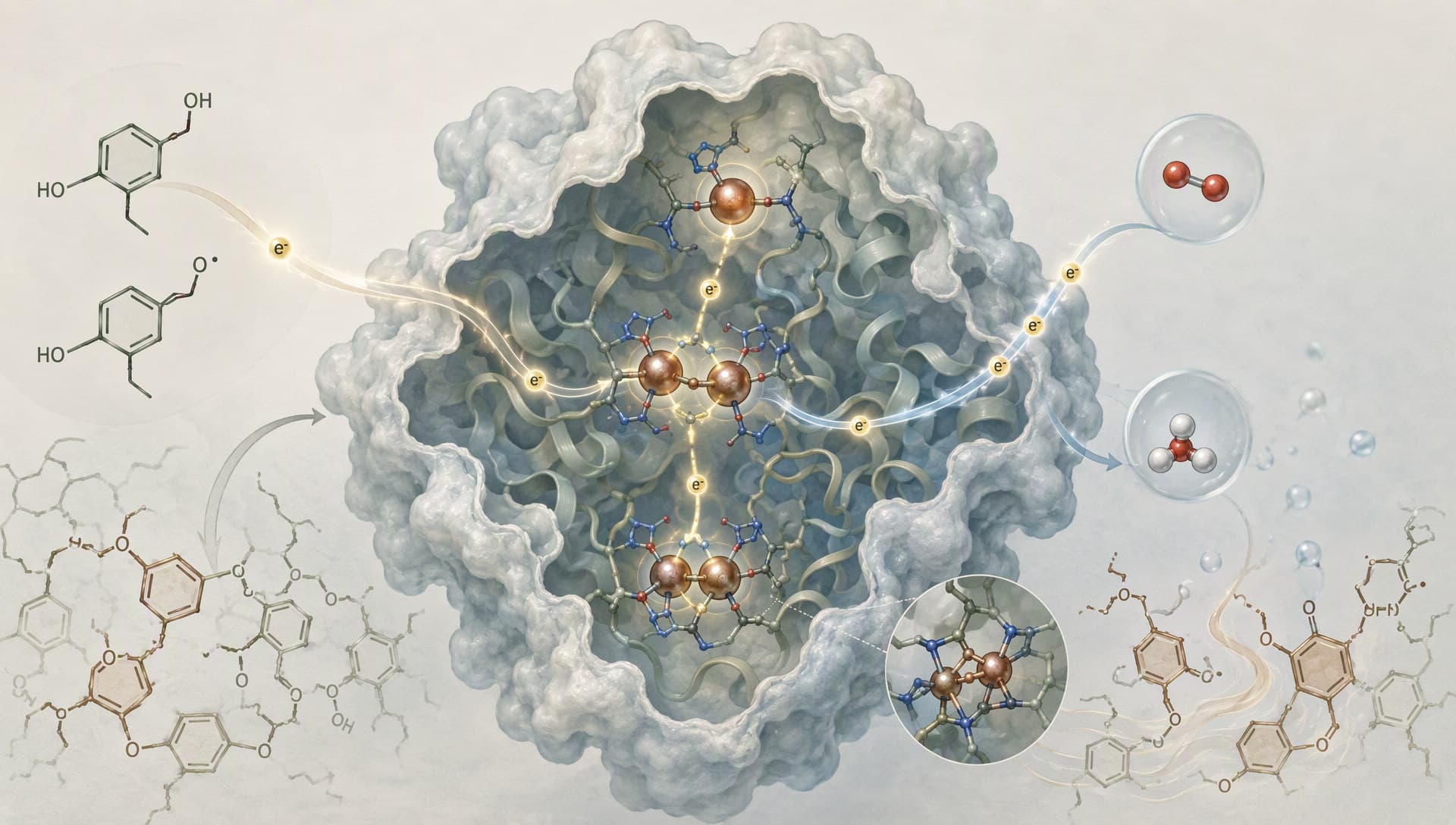
Multicopper oxidation pathway|Laccase mechanism at the copper center
Category: Biotechnology; Industrial Enzymes; Oxidoreductases; Protein Engineering; Fermentation; Environmental Biotechnology; Textile and Pulp Processing
Abstract
English Abstract: Laccase couples substrate oxidation to oxygen reduction. Learn mediator use, selection, immobilization, fermentation, and scale-up.
What laccase does and why its multicopper center matters
Laccase is not simply an enzyme that “breaks down” a named material. Its defining function is single-electron oxidation. A substrate loses an electron near the enzyme surface, and that electron moves through the protein to an internal copper cluster where oxygen is reduced to water. Because oxygen acts as the terminal electron acceptor, the reaction may avoid a stoichiometric dose of a strong chemical oxidant. However, oxygen transfer, substrate accessibility, and enzyme stability become central process variables.
The copper sites perform distinct roles. A site near the substrate-facing region accepts electrons, while the internal cluster binds and reduces oxygen. The complete catalytic cycle depends on metal occupancy, protein conformation, and the surrounding amino-acid environment. Expression, purification, or storage conditions that disturb copper loading can lower effective catalytic capacity even when the measured protein concentration remains high. Activity, protein amount, metal status, and stability should therefore be considered together.
Substrate range varies among enzyme candidates. Phenolic compounds, aromatic amines, and selected other aromatic molecules may undergo direct oxidation, but reaction rate depends on redox properties, molecular size, charge, and access to the catalytic region. Large or difficult substrates may react too slowly for a useful process. That is the point at which a mediator system can be evaluated rather than assumed.
How a laccase mediator system expands reach and risk
A mediator is a small molecule that is first oxidized by the enzyme and then transfers oxidative capacity to a target substrate. It can act as a bridge between the active site and a molecule that is too large, poorly accessible, or difficult to oxidize directly. This can expand the effective chemical and spatial range of the catalyst, particularly for lignin fragments, selected dyes, and complex aromatic materials.
The added reach comes with additional variables. A reactive mediator intermediate may affect both the intended substrate and valuable matrix components. Changes in color, polymer length, flavor, fiber integrity, or downstream fermentation may follow. Residual mediator, treatment cost, recovery, and suitability for the end use must also be considered. Food and beverage processes require especially careful evaluation of processing suitability and final quality.
Environmental treatment should not use decolorization as the only endpoint. A loss of visible color does not establish complete conversion or an acceptable product profile. Testing should examine target disappearance, product formation, overall organic load, enzyme retention, and compatibility with later treatment steps. The safest development sequence establishes a mediator-free baseline, compares a small number of candidates, and includes controls for the enzyme, mediator, substrate, and oxygen conditions.
Industrial laccase applications require a process endpoint
Textile processing may investigate dye oxidation, decolorization, or fiber-surface modification. Before an enzyme enters a formulation, its compatibility with surfactants, salts, auxiliaries, and the temperature program must be tested. Color difference, fiber strength, and subsequent finishing performance matter together. A lower absorbance in a laboratory tube is not enough to establish manufacturing value.
Pulp and plant-fiber applications focus more heavily on lignin-associated aromatic structures. Enzymatic oxidation can be evaluated within biobleaching, fiber modification, or refining workflows. Performance depends on feedstock identity, lignin accessibility, mediator strategy, and surrounding unit operations. Brightness, strength, drainage behavior, and chemical demand should be monitored together so that an attractive appearance does not conceal a loss in material quality.
Environmental biotechnology may use the catalyst to transform phenolic wastewater components, dyes, and selected aromatic contaminants. Real samples can contain salts, metals, solvents, particles, and competing organic matter that alter activity. The useful question is not merely whether a target signal declines. Product profile, total load, enzyme consumption, reactor operation, and compatibility with subsequent treatment all need to support the same decision.
Food and beverage research may investigate polyphenol conversion, clarification, flavor stability, or a defined processing aid function. Sensory properties, nutrient retention, process constraints, and residual activity should remain part of the assessment. Biosensing uses shift the focus toward immobilization, electron transfer, response range, interference, and batch consistency.

Industrial oxidation map|Laccase applications in textile and pulp processing
How to select laccase beyond a declared activity value
Selection begins with a measurable endpoint. The goal may be to lower a target concentration, change color, modify lignin, form a polymerized product, improve a sensor response, or reduce the burden on a later step. Each endpoint creates a different tolerance for side reactions and a different requirement for substrate range. “We need an oxidase” is not yet a product profile.
Activity units must be interpreted with the assay conditions. Chromogenic substrates, pH, temperature, reaction time, and unit definitions can produce values that are not directly comparable. A standard substrate is useful for screening candidates under controlled conditions, whereas the real feedstock determines process relevance. Initial activity, residual activity after a defined period, and conversion of the target substrate should be measured together.
The operating window is equally important. Fungal, bacterial, and plant-associated enzymes can differ in pH preference, temperature behavior, salt tolerance, and secretion pattern. An assay optimum may not be the best production condition because the actual matrix introduces viscosity, mass transfer, solvents, oxygen demand, and shear. High-solids or viscous systems are particularly vulnerable to local oxygen limitation and uneven mixing.
Formulation changes practical performance. Liquid and solid products differ in storage, transport, dosing, and dust control. Buffers, stabilizers, preservatives, and metal ions can affect long-term activity. If the process uses immobilization, the selection program should also measure diffusion, enzyme leakage, cycle life, cleaning tolerance, and regeneration.
A useful screening funnel starts broad and becomes progressively realistic. First, compare several candidates with one controlled assay. Second, remove candidates that fail basic pH, temperature, or storage requirements. Third, test the remaining set in the real material with the intended oxygen and mixing conditions. Finally, evaluate downstream product quality and processing. This sequence prevents a convenient laboratory number from dominating a manufacturing decision.
When immobilized laccase is worth the added complexity
Immobilization confines the enzyme to a carrier surface or pore network. It can simplify recovery and may improve operational stability or repeated use. These benefits are attractive for continuous operation, multi-cycle processing, or products that should not contain free protein. Yet the carrier adds a diffusion path, and attachment can obstruct the catalytic region or alter conformation. Lower apparent initial activity is therefore possible.
The decision should compare enzyme consumption per unit product, carrier cost, cycle life, reaction time, cleaning, and final-product handling. A first-cycle activity comparison is insufficient. Large substrates, suspended solids, or fouling compounds can reduce the advantage of porous carriers by limiting transfer or blocking access. Co-immobilized mediator systems add further questions about mediator leakage and electron-transfer efficiency.
Pilot experiments can compare free enzyme with two carriers that have clearly different structures. Each cycle should record conversion, residual activity, pressure drop or mixing behavior, and product quality. Immobilization becomes persuasive only when cumulative output and operational stability compensate for carrier preparation and slower transfer.

Selection and scale-up path|Laccase selection and fermentation development
Connecting laccase fermentation with protein engineering and scale-up
Industrial development starts with a target product profile. The team should define the substrate, operating pH and temperature, mediator strategy, storage period, formulation, impurity limits, and cost boundary. It can then decide whether to search for a natural candidate or engineer an existing protein.
MatwingsVenus®(晓鹜®) can organize natural protein discovery, protein-property prediction, and engineering of an existing protein as distinct tasks. These capabilities can help narrow candidate space, assess properties such as stability or preferred conditions, and formulate engineering hypotheses. Computational outputs guide experimental design; they do not replace measured activity, substrate profile, copper loading, or process stability.
After candidate selection, the expression system affects secretion, folding, glycosylation, copper loading, and yield. MATWINGS MALL presents Bioprocess Development & Scale-Up services that cover expression-system selection, high-expression strain construction, fermentation and purification development, and stepwise laboratory-to-pilot validation. These are general protein-bioprocess capabilities that can connect a candidate with physical production. MatwingsVenus®(晓鹜®) can support candidate review during this transition, while yield, activity, and economics still require project-specific verification.
Fermentation development must address carbon and nitrogen supply, induction, dissolved oxygen, feeding, foam, and protein degradation. Copper-related conditions require careful control so that enzyme maturation is supported without compromising cell performance, equipment, or downstream purification. Oxygen transfer and mixing in a flask cannot be enlarged by volume ratio alone. Reactor development needs controlled ranges for agitation, aeration, feed, and sampling.
Purification should reflect the intended use. Environmental or material-processing products may have different purity targets and tolerance for side activities than analytical or sensing products. MATWINGS MALL also presents Commercial-scale CDMO Manufacturing with optional strain revival, fermentation, purification, formulation, packaging, mature-process transfer, and continuing optimization. Before transfer, a project should assemble strain information, critical parameter ranges, quality methods, stability data, and deviation procedures.
MatwingsVenus®(晓鹜®) can continue to support candidate-property assessment and engineering iterations, while MATWINGS MALL services address bioprocess development and physical manufacturing. These roles should remain distinct and connect through wet-lab testing, quality control, and real-application validation. That connection is what converts promising oxidation chemistry into a repeatable industrial process.
FAQ
How is laccase different from a peroxidase?
Both participate in oxidation, but their oxidant requirements and catalytic cycles differ. Laccase typically uses oxygen directly, whereas many peroxidase reactions require a peroxide. Substrate fit, process conditions, and side reactions still determine the better option.
Is more mediator always better?
No. Excess mediator can increase non-target oxidation, residual burden, and cost. Start with a mediator-free baseline and compare a small candidate set in the real substrate while monitoring products.
Does high activity on a standard substrate predict industrial performance?
Not necessarily. A standard assay represents a defined test system. Real performance also depends on accessibility, oxygen transfer, salts, solvents, temperature, and long-term stability.
Does immobilization always reduce cost?
No. It can improve reuse but also introduces carrier cost, diffusion resistance, and activity loss. The decision should be based on cumulative multi-cycle output and total process cost.
What should be confirmed before scale-up?
Freeze the product profile and quality endpoint first. Then verify expression, fermentation, purification, formulation, storage, and application performance step by step rather than increasing volume without a controlled parameter range.
Conclusion
A successful laccase process translates multicopper oxidation chemistry into a measurable production endpoint. Development should begin with the real substrate, oxygen supply, and selectivity before deciding whether a mediator is needed. Candidates can then be compared under a common method and tested for sustained activity in the process window. Immobilization should be judged by cumulative value, while fermentation scale-up must connect expression, copper loading, oxygen transfer, purification, formulation, and quality control. When candidate decisions, wet-lab evidence, and manufacturing services remain aligned, catalytic promise can become a stable and repeatable process.