
How to Run Directed Evolution Under Low-Throughput Conditions: Make Every Experiment Count
Published on October 20, 2026
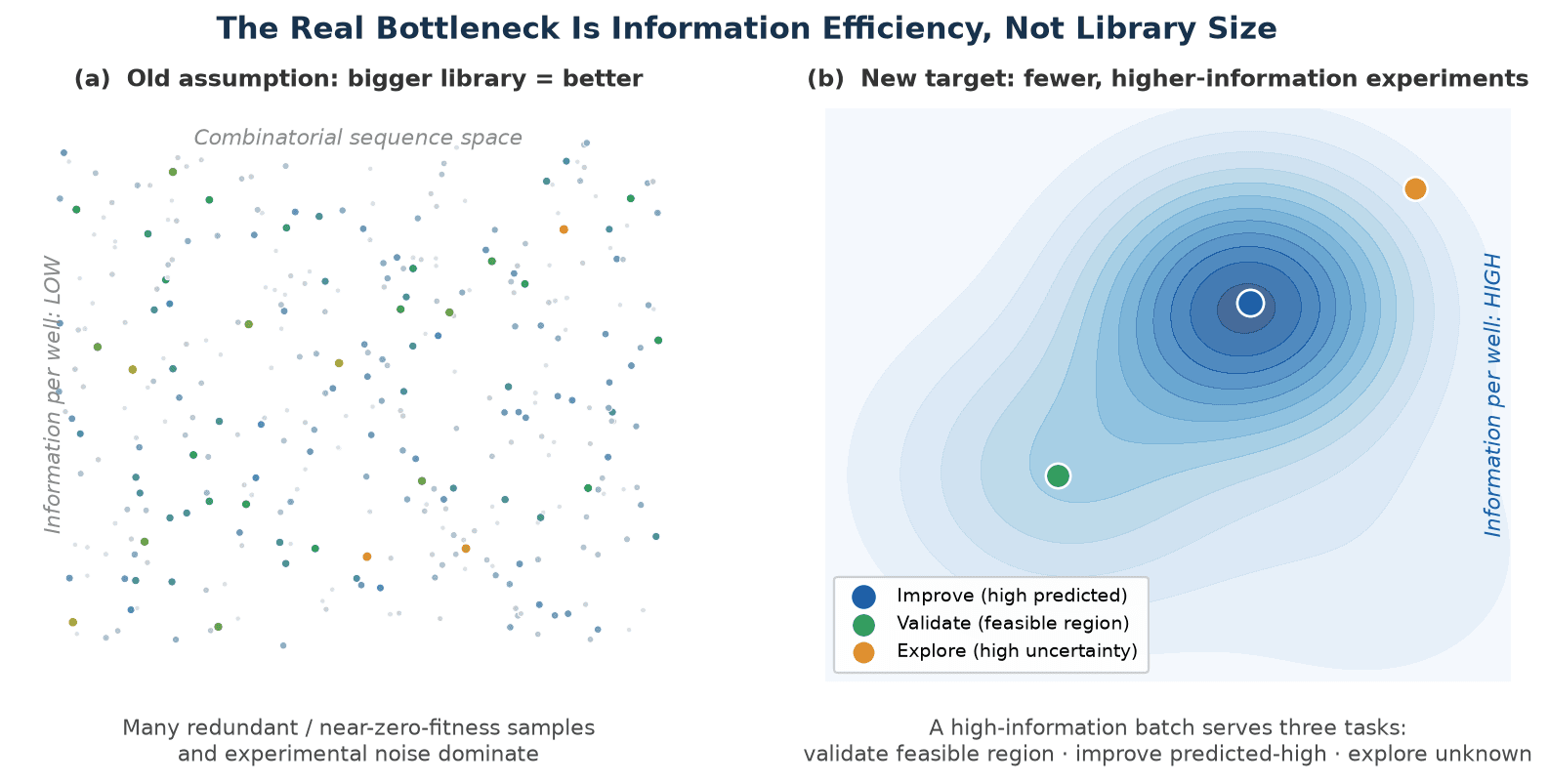
Fig. 1. Information efficiency, not library size or equipment count, is the real bottleneck under low-throughput screening.
Category: Domain | protein engineering; Method | directed evolution; Application | AI for Science
1. The Real Bottleneck Is Information Efficiency, Not Library Size or Equipment Count
Even with limited experiments, you can approach a better protein along high-information paths — provided you change the evaluation criterion: not “how many did we measure this round” but “did this round reduce uncertainty for the next one?” Traditional directed evolution often treats “bigger library is better” as the default premise. But protein sequence space grows roughly exponentially with mutation combinations, and multi-site combinations also show non-additive (epistatic) effects. Continuing to expand a random library under low throughput typically yields repeated similar sequences, low-activity samples filling the slots, and experimental noise masking real differences.
A high-information batch should serve at least three tasks at once:
Validate the feasible region — confirm which sequence neighborhoods still fold, express, or retain basic function.
Improve the promising region — prioritize candidates with high predicted value and mechanistically interpretable roles.
Explore the unknown region — keep a few diverse or model-uncertain samples to avoid premature convergence.
2. How to Do It: First Shrink and Clarify the Search Space (Evidence–Site–Constraint, a Three-Step Method)
Low throughput is not about randomly cutting a large library down; it is about reducing ineffective combinations on a sound basis. A more robust starting point can be summarized as the “Evidence–Site–Constraint” three-step method.
2.1 Establish a traceable wild-type baseline
Retrieve known sequences, structures, functional annotations, kinetic data, and public mutation information, then add the team’s own expression, activity, stability, or affinity data. Every conclusion should be separated into measured, predicted, and unknown, avoiding the temptation to treat computed scores as experimental facts. A conversational protein-R&D agent can help pool database clues, sort evidence status, and generate a to-be-verified list, but data not actually retrieved should remain “unknown.”
2.2 Mark key functional residues as a “no-touch zone”
Combine known annotations, structural neighborhood, evolutionary conservation, and functional-site prediction to first flag catalytic residues, binding hot spots, conformational switches, and potential structural cores. Unless the research goal is to reshape these regions, protect them first. An intelligent workflow can link site retrieval, functional-site mapping, and single-mutation effect assessment to provide an explainable ranking basis for candidate sites.
2.3 Control combinatorial complexity
Rather than opening a dozen sites at once, first choose a small number of sites that are mechanistically complementary and spatially dispersed. If using data-driven active learning, also confirm uniform experimental-data format, consistent measurement direction, and keep the wild type and necessary controls. Some active-learning workflows impose explicit requirements on site count and input data; check the actual tool contract before starting.

Fig. 2. Evidence–Site–Constraint (a three-step method) shrinks and clarifies the search space before sampling.
3. Model and Experiment Collaborate in a Closed Loop to Keep Raising Sample Informativeness
The value of a conversational agent is not promising a one-shot optimal solution, but organizing retrieval, site constraints, candidate ranking, backfilling experimental data, and next-round recommendations into a traceable pipeline. For heavy computation such as mutation design and modeling, researchers should still confirm the inputs, objectives, and expected outputs before execution. From site constraints to experimental backfill, the decision chain is clear and traceable.
The following practices most easily waste limited throughput and should be avoided:
Picking only the model’s top-scoring candidates — easily trapped in local optima and fails to improve the model’s judgment about unknown regions.
Concatenating historical data directly — if substrate concentration, temperature, or detection windows differ across batches, labels may be incomparable.
Recording only successful variants — failures help the model identify ineffective regions; keep them together with their conditions.
Opening too many sites at once — the combinatorial space explodes and limited experiments quickly lose coverage meaning.
Writing predicted values as measured values — single-point scans, combinatorial modeling, and structure scores should be labeled as predictions and confirmed by wet-lab experiments.
4. An Executable Process: A Five-Step Closed Loop
Step 1: write “better” as a measurable metric. Clarify the primary objective, constraints, and kill line. For example, if the primary objective is catalytic activity, constraints may include expression level, stability, and substrate selectivity. Do not frequently change the label definition mid-course, otherwise different rounds are hard to combine for training.
Step 2: design a small but diverse first-round sample. The first round is not only the highest-predicted variants. Mix existing good variants, local single-point variants, mechanistically reasonable combinations, and a few high-uncertainty candidates. Existing studies indicate that training-set design itself significantly affects machine-learning-assisted directed evolution, and too many near-zero-fitness low-information samples may waste limited slots.
Step 3: unify experiments and QC. Use fixed batch controls, technical replicates, and consistent data normalization. Low-throughput projects have few data points, so the effect of one outlier is amplified; when necessary, reduce candidate count rather than drop controls and replicates.
Step 4: let the model consider both “potential” and “uncertainty.” Multi-point combinatorial modeling can rank candidates, while active learning decides what the next batch should validate. It is recommended to split the slots into three parts: exploit high-prediction candidates, explore high-uncertainty candidates, and validate sequence-diversity candidates. The ratio need not be fixed; adjust it with round and model calibration.
Step 5: iterate in small batches and set a stopping rule. Backfill real experimental values, record failed samples and conditions, then retrain or update the model. When improvement plateaus for several consecutive rounds, candidate differences converge, or validation cost exceeds expected benefit, stop expanding and move to mechanistic validation and replication.
This process explains how to run directed evolution under low throughput: computation narrows the choice, experiment supplies true labels, and both correct the direction through multi-round feedback rather than replacing the assay with prediction.

Fig. 3. A five-step closed loop couples model and experiment so that each round raises the information per sample.
Frequently Asked Questions
Can I start with very little data?
Yes, but lower the model complexity, prioritize label consistency, and improve first-round sample quality with prior evidence and structural constraints. The goal of the first round is to establish a learnable signal, not to find the global optimum immediately.
How many variants should I test each round?
There is no fixed number that fits all projects. It depends on available wells, control and replication needs, measurement noise, and candidate diversity. The key is to keep exploitation, exploration, and QC slots in every round.
What if there is no protein structure?
Use sequence annotations, conservation, homolog information, and existing functional data to narrow the range first; when structure-related judgment is needed, use a predicted structure and make clear it is a prediction. Do not skip functional-site protection just because an experimental structure is missing.
How do I avoid overfitting in low-throughput directed evolution?
Keep an independent validation set, control feature and model complexity, monitor prediction uncertainty, and check experimental consistency across rounds. Final candidates should be re-tested and, if needed, validated mechanistically or structurally.
Summary: Turning Limited Experiments into a Continuous Learning Asset
How to run directed evolution under low throughput is essentially an experimental-design problem: first shrink the space with evidence and functional constraints, then start the model with a high-information first-round sample, select the next batch via active learning, and let each round’s real measurements flow back into the decision system. To reduce tool-switching and information gaps, one can use a conversational protein-R&D agent that combines database retrieval, functional-site analysis, mutation assessment, multi-point combinatorial modeling, and iterative experimental data — first clarifying the objective and data conditions, then generating an auditable, executable small-batch evolution plan.