
Why Papain Efficiently Cleaves Protein Substrates?
Published on October 20, 2026
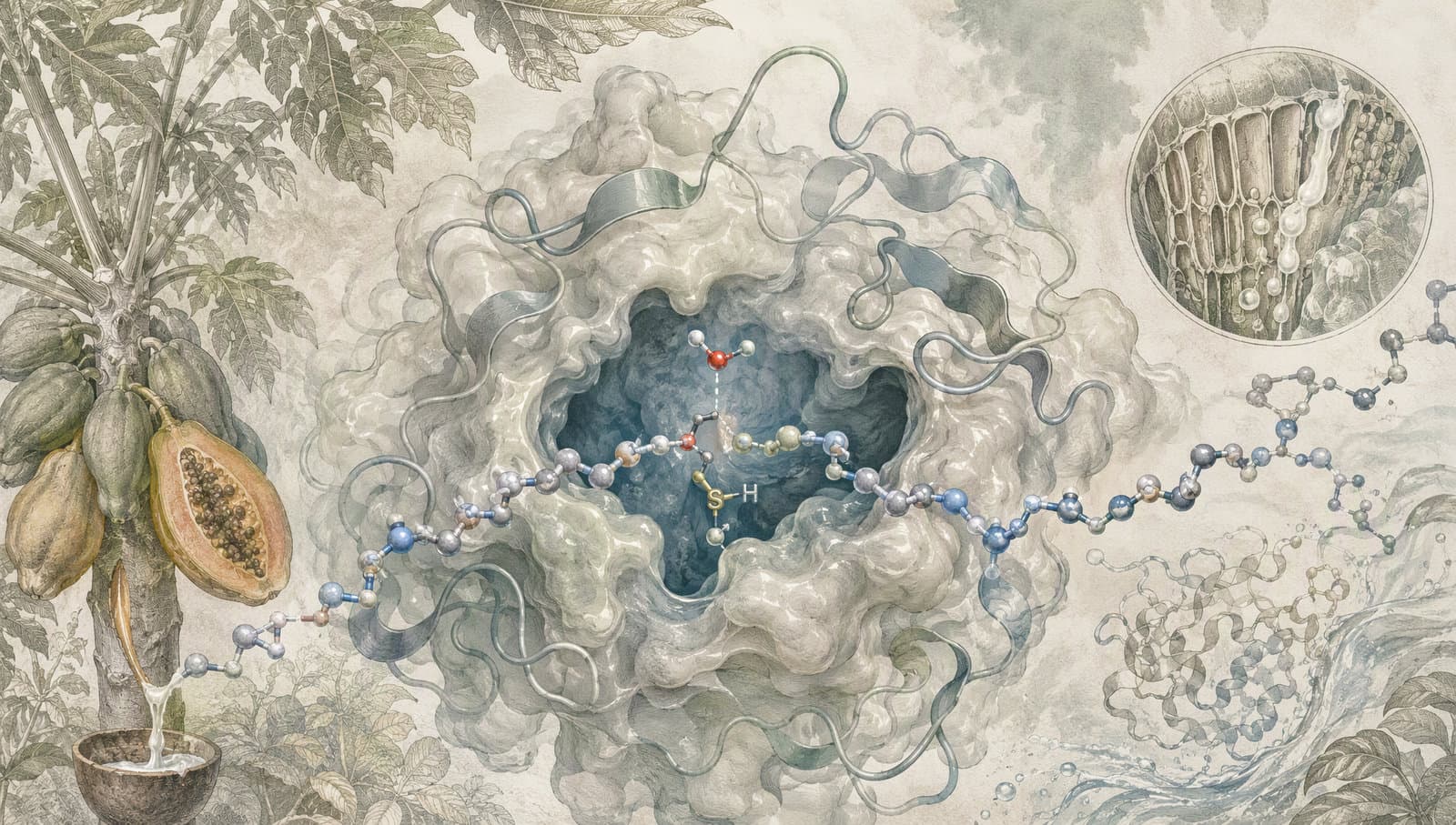
Papain mechanism and peptide-bond hydrolysis
Category: Biotechnology | Enzyme Engineering | Protein Hydrolysis
Abstract: This article explains papain nucleophilic catalysis, substrate pockets, and evolving cleavage windows, then develops practical guidance for activity assays, cleavage mapping, protease-route selection, recombinant expression, fermentation, purification, and scale-up control.
Why the papain mechanism depends on an active thiol
Papain is a cysteine protease. Its defining feature is not simply that it cuts proteins, but that the thiol group of an active-site cysteine acts as the catalytic nucleophile. A nearby histidine helps activate this nucleophile, while an asparagine supports the catalytic network. When a substrate enters the active cleft, the enzyme forms a transient covalent intermediate. Water then participates in the later stage, the peptide products are released, and the catalytic state is restored.
This mechanism explains why the chemical state of the catalytic thiol matters. Oxidation or irreversible modification of the key cysteine can reduce activity even when protein concentration, apparent purity, and visual appearance remain unchanged. A reducing environment may help maintain the active state, but more reductant is not automatically better. Additional reagents can alter substrate structure, interfere with assay signals, or complicate downstream operations. Formulation must balance active-site protection with compatibility across the full workflow.
Papain hydrolyzes peptide bonds in many protein substrates, but broad specificity is not the same as randomness. The substrate-binding region responds to residue size, hydrophobicity, and local geometry around a candidate scissile bond, with a preference for a larger hydrophobic side chain at a key neighboring position. Sequence preference remains only part of the outcome. A favorable motif buried inside a folded core may react poorly because it cannot reach the active cleft.
How papain substrate specificity changes the cleavage map
The same protein sequence can produce different cleavage maps in different conformational states. A native fold protects internal segments and exposes flexible surface loops. Partial unfolding opens additional sites. Extensive unfolding may lead rapidly to many small fragments. If a development team records only how much substrate disappeared, it cannot distinguish controlled limited hydrolysis from excessive degradation.
A useful cleavage-window assessment has three layers. The sequence layer identifies regions that may fit the substrate pocket. The structural layer asks whether those regions are exposed, flexible, or located at domain junctions. The reaction layer considers whether pH, temperature, salts, solvents, and mixing alter substrate conformation. A practical cleavage site emerges only from the interaction among all three layers.
Time is a hidden variable in the cleavage map. Early reactions are often dominated by the most accessible sites. As the structure opens, additional sites become available and the product distribution continues to change. Limited hydrolysis therefore requires dense early sampling. More extensive digestion requires a balance among residual large molecules, resistant fragments, and loss of enzyme activity. Every design also needs a validated quench so that samples do not continue reacting after collection.
Substrate concentration and enzyme-to-substrate ratio must be interpreted together. More enzyme can increase the initial rate while shortening the controllable operating window. More substrate can alter viscosity, mass transfer, and effective molecular encounters. Process screening should track initial rate, target-fragment abundance, off-target fragments, aggregation or precipitation, and post-quench stability rather than comparing endpoint conversion alone.

Papain substrate specificity and cleavage window
A papain activity assay should use more than one endpoint
A reliable method answers two different questions: how much catalytic capacity remains in the enzyme preparation, and whether the enzyme creates the required products on the real substrate. Small-molecule or peptide substrates support rapid comparisons and initial-rate analysis. Protein substrates are more application-relevant but introduce conformation, multiple cleavage sites, and product interference. These assay classes complement rather than replace one another.
Method development can start by holding substrate lot and reaction volume constant, then locating an interval in which the signal changes approximately linearly with time and enzyme level. No-enzyme, inactive-enzyme, and reagent-blank controls distinguish spontaneous substrate change, formulation background, and detection interference. If reductants, metals, or additional proteins are present, their effects on absorbance, fluorescence, or color development should be tested separately.
For protein substrates, electrophoresis, chromatography, size-based separation, or mass spectrometry can establish the product map. Each readout should answer a distinct question. A rapid activity signal compares lots and conditions. Size analysis follows substrate loss and fragment distribution. Site analysis identifies cleavage positions. A functional assay determines whether the processed product remains fit for its intended task. A decrease in total intact protein does not prove that the desired fragment has formed.
Method robustness also depends on quenching. A pH shift, an inhibitory condition, or rapid physical separation may stop the reaction, but the method must verify that cleavage truly stops and that the quench does not distort later measurements. The interval among quenching, sample storage, and analysis should be specified because waiting time alone can create apparent differences among identical samples.
Protein hydrolysis control begins by defining where cleavage should occur
Protease selection should not begin by asking which enzyme has the highest activity. The first decision is whether the task needs broad hydrolysis, limited digestion, or processing at a defined sequence. Papain can act on many proteins with accessible sites, but a single short recognition motif rarely guarantees one unique product. A workflow that must release a precursor segment at a defined position may require a protease with stronger sequence constraints.
The public product catalog in MATWINGS MALL presents recombinant Kex2 protease, which recognizes and cleaves peptide bonds after dibasic residue motifs. It represents a sequence-directed processing route that is distinct from papain. The two enzymes should not inherit one another’s substrate assumptions, catalytic classification, or process settings. For recombinant peptide-precursor processing, the choice between a Kex2-type specific protease and a broader papain route should follow the target junction, acceptable byproducts, and downstream purification burden.
Evaluation criteria should then match the task. Limited hydrolysis emphasizes target-fragment abundance, over-digestion products, and timing. Extensive hydrolysis emphasizes residual large molecules, fragment distribution, and lot consistency. Precursor processing emphasizes the intended junction, uncleaved substrate, and off-target cuts. Different objectives produce different preferred enzyme levels and reaction times.
Recombinant papain expression must distinguish precursor and mature enzyme
Papain-like cysteine proteases often require decisions about precursor expression, folding, and activation. A propeptide may support folding and limit premature activity, yet poorly controlled maturation can cause host stress, self-cleavage, or heterogeneous products. Construct design should specify whether it produces a precursor, an activatable proenzyme, or mature protease and should define a different purification and activation assessment for each form.
Expression screening should not rely on band intensity alone. Soluble fraction, precursor-to-mature ratio, purity, specific activity, self-cleavage, and storage stability should be followed together. A high-expression construct that activates poorly may be less useful than a lower-titer candidate that reproducibly yields mature activity. Tag placement also requires validation so that it does not interfere with propeptide processing, the active cleft, or the final formulation.
MatwingsVenus®(晓鹜®) can support protein database retrieval, functional-site analysis, and protein-property assessment. Teams can submit the sequence, species, host, and optimization objective, verify identity and functional sites, and prioritize a small number of engineering candidates for experimental testing. If stability or expression needs improvement, experimentally confirmed catalytic residues can be designated as protected positions while protein-engineering analysis ranks peripheral mutation candidates. Expression, activation, activity, and product-map data still determine which candidate advances.
How papain process optimization moves into fermentation and purification
During the move from shake flasks to bioreactors, temperature, induction intensity, oxygen transfer, culture duration, and host proteases can alter precursor processing and self-cleavage. During purification, pH, ionic strength, redox environment, and residence time can affect mature-enzyme activity. Scale-up should establish a reproducible expression, activation, and storage window rather than trying to reproduce one exceptional activity value.
MATWINGS MALL publicly describes bioprocess development services covering high-expression strain construction, fermentation and purification development, and stepwise laboratory-to-pilot verification. A papain project can use construct selection, mature-enzyme assessment, and the activity method as process inputs while defining critical impurities, formulation, stability, and scale boundaries. Once the candidate and analytical definitions are stable, publicly described protein and peptide production services can inform later production planning.
The same benchmark substrate and activity-unit definition should be retained across research, pilot, and scale-up batches. Consistent substrate preparation, sampling, quenching, and product analysis allow teams to separate equipment-scale effects from analytical drift. When the final task is protein processing, performance on the real substrate should be part of the scale-up decision instead of assuming that strong peptide-substrate activity represents the entire application.

Papain activity assay and process optimization
How MatwingsVenus®(protein design agent)organizes a papain development task
An executable task chain starts with the intended result. A team provides the enzyme sequence, target substrate, desired extent of cleavage, expression host, and process constraints. The platform supports database retrieval, functional-site analysis, and protein-property assessment and outputs a small number of engineering candidates. Wet-lab work then compares expression, maturation, substrate maps, and stability. Only after these data return should the program change a candidate, reaction window, or scale-up route.
This layered approach avoids three common errors: treating every papain-like protein as the same enzyme, equating peptide-substrate activity with real-protein processing, and mutating without protecting catalytic residues. Projects that need sequence-directed processing or production development can also compare the publicly listed Kex2 product and bioprocess services in MATWINGS MALL, while the final route remains governed by the intended junction, product quality, and measured data.
FAQ
Why is papain classified as a cysteine protease?
Its catalytic center uses a cysteine thiol as a nucleophile to attack a peptide bond and proceeds through a covalent intermediate. The chemical state of this thiol therefore directly affects catalytic performance.
Can papain cleave a protein at only one position?
A simple motif usually cannot guarantee one unique papain cleavage site. The outcome depends on sequence preference, site exposure, protein conformation, and reaction time. A route with stronger sequence constraints may be preferable when one defined junction is required.
Why does a peptide assay work when the real protein is resistant?
A peptide presents an accessible bond, whereas the corresponding region in a folded protein may be buried. Substrate conformation, formulation components, enzyme status, and the reaction window should all be checked.
How can excessive papain hydrolysis be controlled?
Lowering the enzyme-to-substrate ratio, shortening the reaction, limiting substrate unfolding, and applying a rapid validated quench can help. Dense sampling is useful for finding the interval with the highest target-fragment abundance.
What indicates that recombinant papain is ready for scale-up?
The program should evaluate precursor processing, mature-enzyme fraction, specific activity, self-cleavage, purification recovery, storage stability, and real-substrate performance under one analytical definition.
Summary
Papain derives its proteolytic power from cysteine-driven peptide-bond hydrolysis, but a useful process requires more than proving that cleavage occurs. Substrate conformation determines access, time reshapes the product map, assays and quenching determine whether results are comparable, and expression and purification determine whether mature activity is reproducible. MatwingsVenus®(晓鹜®) can support identity checks, site analysis, and engineering-candidate prioritization. The publicly listed specific-protease catalog and bioprocess services in MATWINGS MALL provide options for route comparison and later process planning. Final decisions still depend on the target substrate, a defined product standard, and measured results.