
Site-Saturation Mutagenesis Library Design That Matches Screening Capacity
Published on October 18, 2026
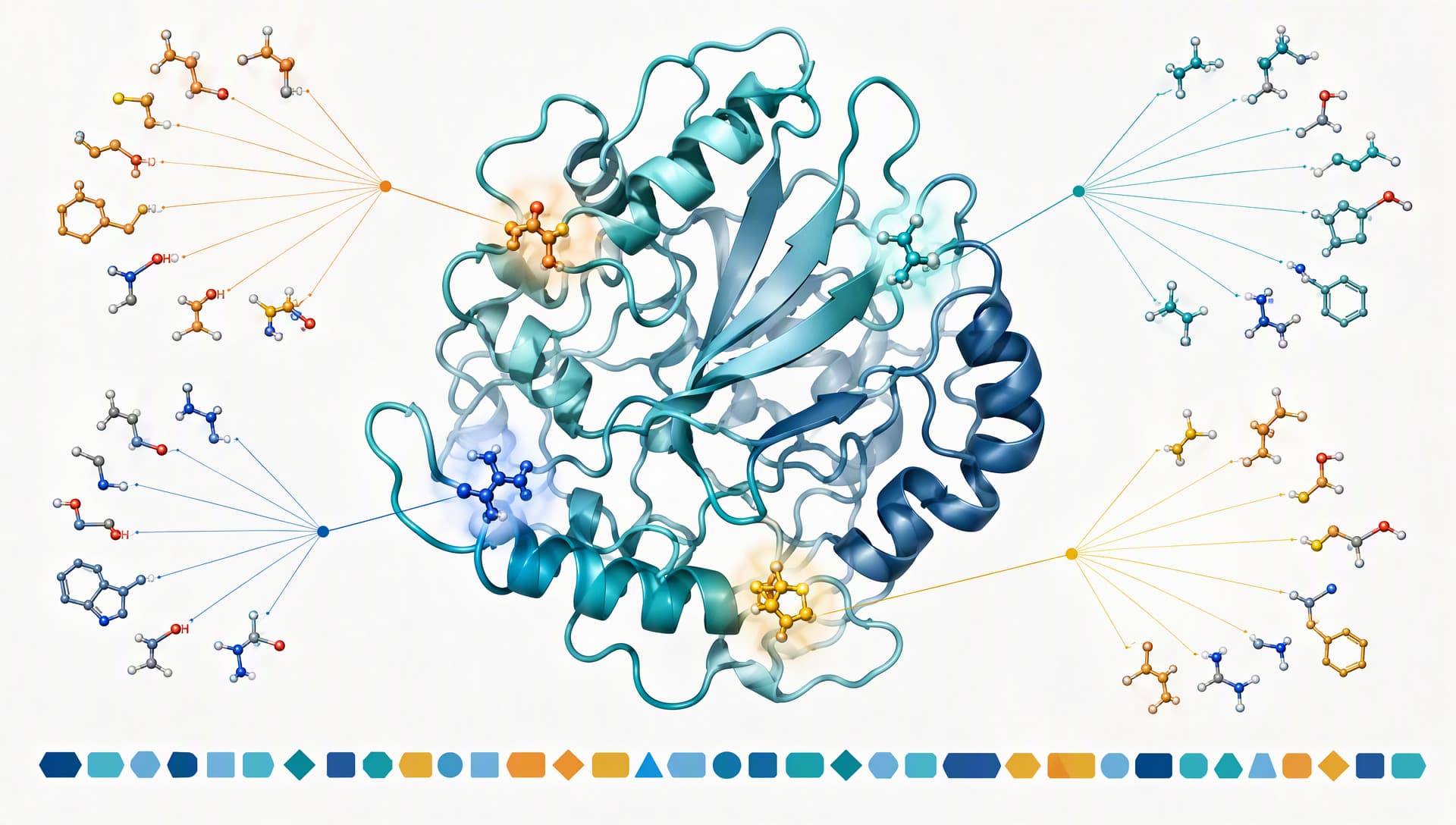
Target sites and side-chain choices jointly define the library boundary
Category: Protein Engineering / Directed Evolution / Mutant Libraries
When a research team asks which amino-acid substitution is most suitable at a particular protein position, a saturation library offers a systematic alternative to testing a few intuitive variants. Diversity is introduced at selected codons, and expression, screening, or selection is then used to detect functional differences. Yet “saturation” describes an intended search space, not a guarantee of useful coverage. A poorly justified site, an assay that cannot resolve the desired phenotype, or a library larger than the available screening capacity can turn impressive diversity into expensive noise.
Site-Saturation Mutagenesis Library Design Begins with a Measurable Question
The first design decision should not be the number of mutants. It should be the phenotype that can be measured reproducibly. Is the objective higher catalytic activity, altered substrate selectivity, stronger binding, better expression, or survival under a defined condition? Each objective requires a different assay window, throughput, and threshold for a positive result. If the readout is weakly connected to the target function, complete substitution coverage will not rescue the experiment.
Only then should positions be selected. Catalytic pockets, access tunnels, interaction interfaces, flexible loops, and distal allosteric networks can all contain useful sites, but they do not carry equivalent structural risk. Highly conserved catalytic residues may be poor candidates for indiscriminate substitution. Positions near a functional region that retain some evolutionary tolerance may offer a more informative balance between change and viability. A defensible plan therefore combines sequence conservation, three-dimensional context, known functional evidence, and a specific mechanistic hypothesis rather than relying on distance alone.
Why the Theoretical Search Space Expands So Quickly
At one site, evaluating all 20 standard amino acids is still conceptually manageable. If every amino acid is combined across two, three, or more positions, the theoretical amino-acid space grows as 20 to the power of the number of sites. Three positions produce 8,000 combinations; four produce 160,000. Those values do not yet include codon redundancy, construction losses, transformation bottlenecks, or uneven clone frequencies.
For that reason, a multi-site project does not have to begin with a complete combinatorial library. A team can first scan individual sites and combine substitutions that show useful signals. It can use structural and conservation evidence to narrow the set of positions. It can also assign a chemically meaningful reduced amino-acid alphabet to each site. These choices do not make the experiment less rigorous. They concentrate finite screening resources on variants capable of testing the underlying hypothesis.
Theoretical diversity must also be separated from actual coverage. A variant that exists on paper may fail during oligonucleotide synthesis, assembly, transformation, amplification, or sampling. A large colony count does not prove that all intended variants are present at similar frequencies. Practical site-saturation mutagenesis library design therefore works backward from the number of variants the assay can process and reserves capacity for bias and sampling loss.
A Degenerate Codon Is a Trade-off, Not an Automatic Solution
NNK and NNS schemes are commonly used because they reduce redundancy relative to NNN, but they do not make amino-acid frequencies uniform and do not completely eliminate stop codons. Some amino acids remain represented by more codons than others. Consequently, a mixture that appears balanced at the DNA level may still sample the encoded protein variants unevenly.
When broad amino-acid exploration is essential, a conventional degenerate scheme may be operationally convenient. When screening capacity is limited, a reduced alphabet or a customized codon mixture can focus the library on side-chain size, polarity, charge, or chemistry appropriate to the local structure. Four checks are especially important: whether the intended amino acids are encoded, whether the stop-codon fraction is acceptable, whether the wild-type codon should remain, and whether synthesis and screening costs fit the plan.

Codon strategy determines amino-acid coverage and practical bias
Quality-Control the Library Before Interpreting Hits
A useful library contains variants, but a trustworthy library also reveals which variants are present. Colony or transformant counts estimate capacity; they do not prove composition. Sampled sequencing or NGS can assess target-site coverage, distribution uniformity, wild-type carryover, missing variants, and unintended mutations. This measurement describes the genotype pool. It does not replace protein-expression measurements or functional assays.
Screening can then proceed in separate wells for relatively direct phenotype measurements, or a pooled selection can be analyzed by sequencing before and after selection. Changes in variant frequency can support a condition-specific functional score. That score is not a universal measurement of protein function: it is tied to the selection pressure, host system, expression context, and analysis model.
Both approaches depend on reliable genotype–phenotype linkage. The DNA identity in a cell, droplet, or well must correspond to the protein that generated the observed signal. Cross-contamination, multiple variants in one compartment, or an overly harsh selection can disconnect enrichment from the intended mechanism. Experimental controls and replicate consistency are therefore part of library interpretation, not administrative details.

Sequencing quality control and functional screening reveal informative variants
How MatwingsVenus®(晓鹜®)Supports Site-Saturation Mutagenesis Library Design
A productive workflow removes weak candidates before synthesis and uses new measurements to improve the next design round. MatwingsVenus®(晓鹜®) can organize public evidence, sequence and structure analysis, mutation prediction, and experimental feedback in one research path. Its computational outputs should be used to prioritize candidates, not presented as experimental observations.
During site selection, VenusX can analyze activity-related, binding-related, and evolutionarily conserved positions. This can help identify candidate regions as well as functional areas that should be treated as constraints. At the substitution level, VenusREM can estimate the potential effects of single mutations on activity, binding, stability, or expression; its pro mode requires a PDB structure. These outputs provide a Predicted-level ranking for deciding which amino acids deserve experimental capacity. They do not mean that a DNA library has been built or a phenotype has been measured.
If evidence from single substitutions suggests that multiple positions may interact, VenusPrime can model multi-point mutation combinations rather than assuming that single-site effects simply add together. For a project that already has experimental measurements and no more than seven candidate positions, ALDE may be considered for active-learning-directed evolution. ALDE requires an experimental data file. It is not a substitute for the first experimental round when no measured feedback exists.
The platform applies HITL confirmation before compute-intensive work and distinguishes Measured, Predicted, and Unknown information. This separation helps researchers see which decisions rest on data, which come from models, and which remain unresolved. The workflow can connect with gene synthesis, protein-expression validation, and protein purification. The exact scope of library construction, codon implementation, and acceptance criteria should still be confirmed for each project before work begins.
A Smaller Library Can Produce a Clearer Answer
A mature design does not maximize theoretical diversity for its own sake. It gives every screened clone a reason to exist: define the phenotype before selecting sites; calculate screening capacity before choosing an amino-acid set and codon strategy; verify library composition before interpreting enrichment. Computational ranking can allocate experimental resources more efficiently, but it cannot stand in for measured activity, stability, expression, or project success.
When structural evidence, computational prioritization, codon planning, NGS quality control, and functional testing form an iterative loop, a saturation library becomes more than a way to generate diversity. It becomes a traceable method for converting sequence variation into comparable biological evidence. Teams preparing a protein-engineering or directed-evolution campaign can use MatwingsVenus®(晓鹜®) to begin with candidate-site analysis, develop a more focused computation-to-experiment plan, and ensure that each subsequent round learns from real measurements.