
Protein Pocket Design: Reshaping a Protein's "Hand for Recognition and Catalysis"
Published on October 27, 2026
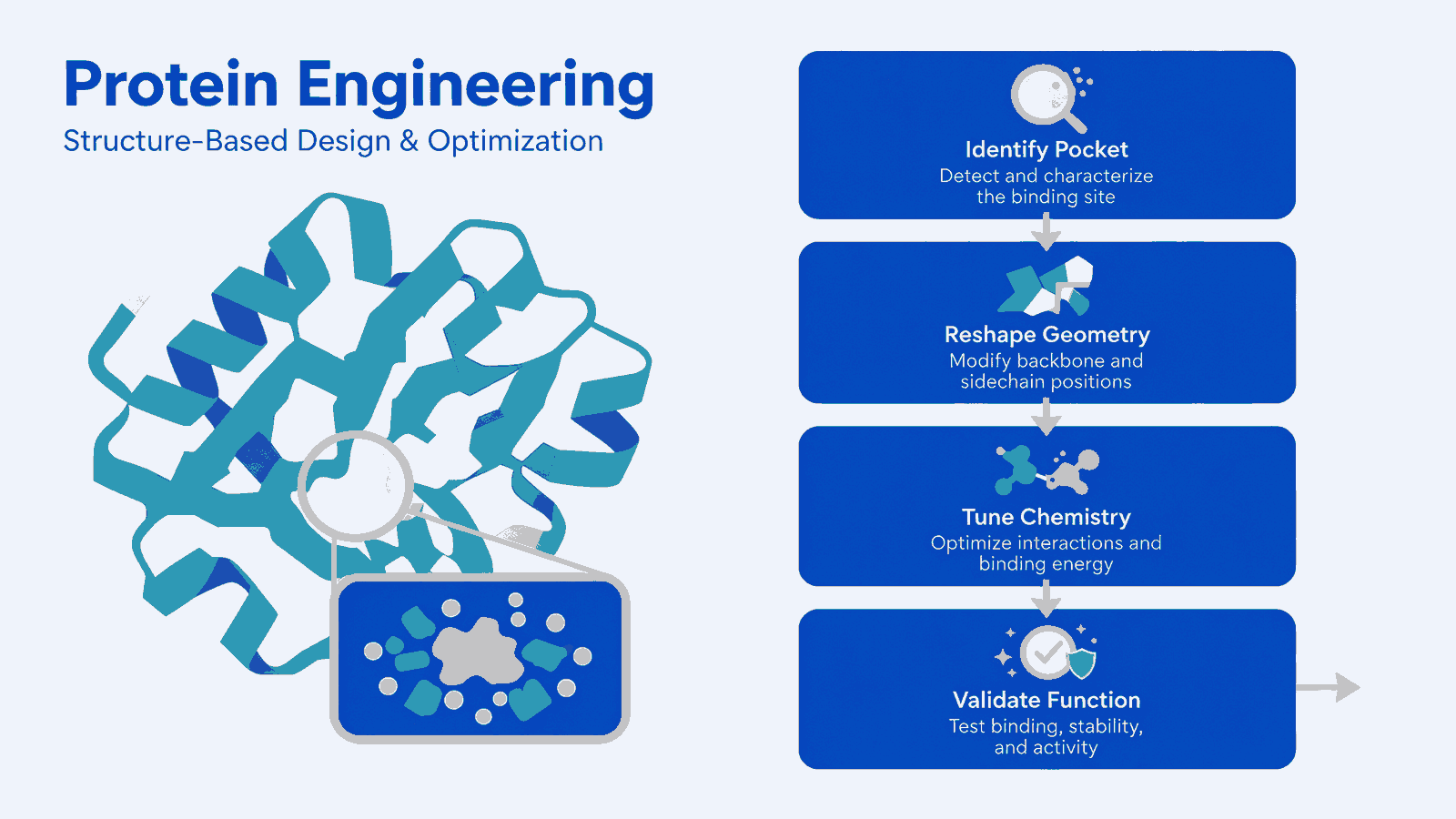
Figure 1: Protein pocket design overview: from recognition to function
A protein is not a uniform, solid block of material; it is a molecular machine full of cavities and grooves. These cavities — which we call pockets — are often the sites where a protein performs recognition, binding, and catalysis. Protein pocket design is the deliberate reshaping of a pocket's shape, size, and chemistry so that the protein binds exactly what you want and catalyzes exactly what you want. It turns the old brute-force "screening the lab" work into a predictable, iterative, and scalable engineering method.
1. Background & Mechanism: Why the Pocket Decides Protein Function
A protein pocket is the "control console" of function: substrate specificity, catalytic activity, and molecular recognition are all delegated to it. The geometry of a pocket determines who can "fit in," while the amino-acid composition of its walls decides whether something docks, gets catalyzed, or is rejected once inside. Understanding the pocket means understanding why an enzyme prefers one substrate and achieves such high selectivity and efficiency.
· Geometric complementarity: The pocket's size, depth, and opening angle act as a "shape sieve" for substrates.
· Chemical complementarity: The hydrophobic/hydrophilic balance, charge distribution, and H-bond donors/acceptors on the pocket wall form a "chemical sieve."
· Recognition and catalysis are two sides of one coin: In many enzymes, the active site is itself a pocket that both grabs the substrate and converts it into product.
Take an industrial example: in drug metabolism or fine-chemical synthesis, the same scaffold often has several reactive sites. A pocket-designed enzyme can "constrain" the reaction so that only the target site is transformed, greatly reducing by-products and purification cost — precisely the value that distinguishes pocket design from ordinary screening.
Understanding this mechanism is the prerequisite for all subsequent design, assay, and process work: every modification ultimately lands on the pocket as a measurable geometric–chemical object.
2. Principles & Structure: The "Geometry + Chemistry" Dual Principle of Pocket Design
Protein pocket design is essentially an optimization trade-off between shape complementarity and chemical complementarity, using structural information to resolve the changes down to specific residues. It is not simply "dig the pocket bigger," but rather reshapes a functional cavity that both selectively recognizes and efficiently catalyzes, without destroying the protein's overall folding stability.
· Shape design (geometry): By adjusting side-chain orientation, loop conformation, and the overall cleft on the pocket wall, you control the pocket's volume, depth, and entrance, and thus the range of substrates it can accommodate.
· Chemical design (chemistry): By swapping key residues you alter hydrophobic/hydrophilic balance, charge, H-bond networks, aromatic stacking, and metal coordination, thereby determining the strength of the pocket–substrate interaction.
· Key residues as functional switches: In many cysteine proteases, for example, the catalytic triad (e.g., Cys25–His159–Asn175) is formed by a few key residues inside the pocket; changing any one often rewrites catalytic activity.
· Structural information is the "blueprint": Designing from scratch is "de novo design," while modifying an existing scaffold is "directed modification." Both rely on accurate knowledge of the pocket's 3D structure.
It is worth stressing that pocket design is not "cost-free" improvisation: every change to the chemistry of the pocket wall usually carries a price — possibly losing stability, lowering expression yield, or rewriting substrate specificity. As a result, good pocket design is often a multi-objective trade-off that requires structural and sequence information to be weighed together.

Figure 2: Pocket design: geometry and chemical complementarity
3. Assay & Selection: How to Judge Whether a Pocket Design Works
Judging whether a pocket design succeeds comes down to three things: does it fold stably, does it match the target, and does the performance reach expectation. A "beautiful pocket" computed in silico only earns its place in the next iteration after real assay validation. Selection is essentially the process of picking the most deployable candidate from a pool of pocket designs.
· Structure validation: Use X-ray crystallography, cryo-EM, or homology modeling to confirm that the pocket geometry was truly reshaped.
· Binding and activity assays: Quantify whether the change improves performance via binding affinity (KD / IC50), catalytic kinetics (Km, kcat, kcat/Km), substrate specificity, and enantioselectivity.
· Stability and developability: Check thermostability, expression yield, solubility, and aggregation tendency after modification, to avoid "pretty design, poor production."
· Three selection questions: (1) Does it preserve overall protein folding? (2) Does it improve target performance? (3) Is it suitable for scale-up? Only when all three pass is it worth advancing.
For many teams, the real bottleneck is often not "how to change it" but "how to validate it quickly." High-throughput screening, automated construction, and parallel assays compress a design cycle from months to weeks — the foundation for truly running the design–build–test–learn loop.
4. Conditions & Process: From Lab Design to Industrial Deployment
For pocket design to create real value, it must clear the hurdle from "optimize" to "process": pH, temperature, buffer, and substrate concentration all affect how the pocket actually performs. A pocket that is optimal in a test tube may lose its advantage if the reaction conditions do not match; conversely, appropriate process conditions can amplify the design's benefits.
· Condition sensitivity: pH shifts the protonation state of residues in the pocket, temperature changes pocket conformational flexibility, and ionic strength affects electrostatic interactions — all of which alter the pocket's actual working state.
· Exogenous environment fit: Non-aqueous phases, high substrate concentrations, and high or low temperature require the pocket design to be co-optimized with real process conditions.
· Dry-wet closed loop: Connect computational design with wet-lab validation in a Design–Build–Test–Learn cycle, feeding every round of assay results back into the algorithm to continuously approach the optimal pocket.
At the scale-up stage, you must also consider mass transfer, substrate solubility, product inhibition, and the enzyme's long-term stability. A pocket that performs well in a small reactor only counts as a real leap from design to process if it retains its selectivity and activity after scale-up.

Figure 3: Dry-wet closed loop: design-build-test-learn
5. MatwingsVenus®(晓鹜®): Putting Pocket Design into an AI Closed Loop
MatwingsVenus®(晓鹜®)upgrades protein pocket design from "trying single residues" into a computable, learnable, and reviewable engineering system. With structure-guided and sequence-correlated analysis, it helps R&D teams find better pocket solutions quickly between geometry and chemistry, and uses a dry-wet closed loop to refine designs into manufacturable parameters.
· Structure-guided design hooks: For pocket and active-site scenarios, provide residue importance and functional-site mapping, turning "where to change" into visible evidence.
· Multi-scale sequence–structure analysis: Combine sequence conservation, evolutionary information, and structural context to help judge which positions are "functional switches" and which only tolerate fine tuning.
· Dry-wet closed-loop platform: Link computational design and wet-lab validation into one loop, so each round of lab data flows back into the model, continuously iterating the pocket design and shortening the design→validate→redesign cycle.
· From design to process: With wet-lab selection and expert-center support, help teams stably carry a designed pocket into scaled-up process conditions.
Together, these capabilities form a complete path from "identifying the problem" to "deploying the process," turning protein design from a method in papers into productivity on the production line.
6. FAQ
Q1: What exactly is protein pocket design?
Protein pocket design is an engineering method that reshapes the geometry and chemistry of a protein's binding pocket to precisely control substrate recognition, binding affinity, and catalytic activity. Its core is not simply "digging the pocket bigger," but reshaping a functional cavity that both selectively recognizes and efficiently catalyzes without destroying protein stability.
Q2: How is protein pocket design usually done?
The workflow typically has four steps: first obtain or predict the pocket's 3D structure; then propose candidate designs using geometric and chemical complementarity; then screen them with structure validation and binding/activity assays; finally feed the results back into the algorithm for the next iteration. This "design–build–test–learn" cycle is the efficient path of modern pocket engineering.
Q3: Where can protein pocket design be used?
Common scenarios include improving enzyme substrate specificity and enantioselectivity, increasing antibody or receptor binding affinity, reshaping the substrate preference of transport and recognition proteins, and designing new active sites to catalyze non-natural reactions. Because almost any "recognition + catalysis" function is realized through a pocket, the application space is very broad.
Q4: How can MatwingsVenus®(晓鹜®)help with pocket design?
MatwingsVenus®(晓鹜®)provides structure-guided pocket analysis, key-residue functional-site mapping, and dry-wet closed-loop services, helping R&D teams quickly locate better pocket candidates and continuously feed experimental results back into the model, shortening the iteration cycle from design to industrial process.
7. Summary
The essence of protein pocket design is to turn a protein's recognition and catalytic capability into measurable geometric–chemical parameters using structural information, then convert those parameters into stable industrial performance through assay and process. Geometric and chemical complementarity are the two wheels; structure validation and activity assay are the brakes; and the dry-wet closed loop is the engine that keeps the machine accelerating. When an AI protein design platform turns the "pocket" from guesswork into a predictable, engineerable, and deployable engineering object, enzyme engineering and protein design truly enter the era of precision. MatwingsVenus®(晓鹜®)is ready to work with you to turn every pocket into a function that can be realized industrially.