Uncultured Microbial Enzyme Discovery: Unlocking the Hidden Enzyme Library
Published on October 26, 2026
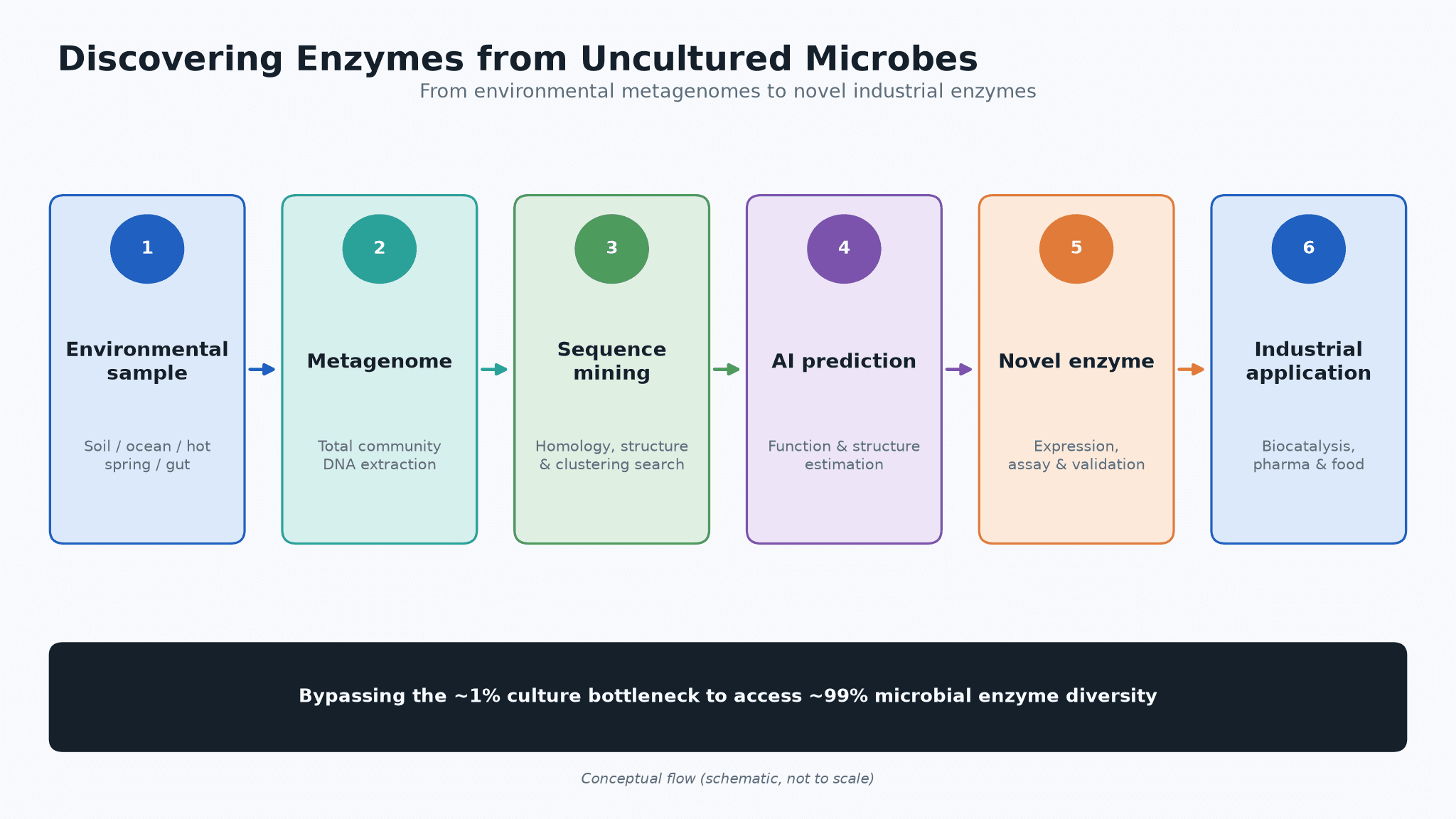
In nature, only a tiny fraction of microorganisms can be coaxed to grow in the laboratory. By long-standing scientific consensus, more than 99% of microbes cannot yet be cultured by conventional methods — which means the enzymes they encode have long been out of view. Uncultured microbial enzyme discovery aims to open this overlooked door: instead of relying on culture, we read the "total DNA" of an environment and use AI to pick out usable enzymes from vast sequence pools. This article walks the new path from environmental sample, to sequence, to industrial product.
1. Background: Why Do ~99% of Microbial Enzymes Stay "Invisible"?
Traditional enzyme discovery depends on "culture first, then screen": grow the microbe in a plate, then measure its activity. But in reality most microbes are extremely picky about culture conditions and simply will not grow in the lab, leaving an enormous "dark-matter" enzyme library untouched.
Metagenomics sidesteps the culture step: it extracts, fragments and sequences the DNA of all microbes in an environmental sample (soil, ocean, hot springs, gut, compost, and more), yielding the "total genome" of the whole community. Even if we cannot grow these microbes, we can now "read" their genes — including countless enzymes never studied before.
That is the core logic of uncultured microbial enzyme discovery: expand the enzyme library from "what we can culture" to "what we can read."
2. Principle: Mining Enzymes from Environmental DNA with Metagenomics + AI
Finding genuinely useful enzymes in a pile of sequences usually follows two main routes.

Key mechanism: two routes of metagenomic enzyme mining enhanced by AI
• Sequence-based mining: use a known enzyme's sequence or structure as a "seed" to search for homologues in the metagenome. Well suited to finding "new members of a known family," such as novel thermostable esterases, proteases or glycosidases.
• Function-based screening: transfer metagenomic DNA fragments into an expression host (e.g., E. coli) and measure activity directly. Well suited to discovering "never-seen catalytic functions" — even if the sequence is unfamiliar, as long as it works.
Each route has trade-offs: sequence mining is fast and high-throughput but tends to find known families; function-based screening can reveal entirely new functions but is slower and more demanding to screen.
AI is accelerating both at once: protein language models predict structure and function directly from sequence, helping to rank, de-duplicate and shortlist the most "usable" enzymes from billions of candidates; structure-prediction tools extend "sequence similarity" to "structural similarity," catching enzymes with low sequence identity but similar function. AI enzyme mining does not replace wet-lab work — it concentrates limited experimental resources on the candidates most worth validating.
3. Screening & Selection: How Do You Judge a Good Hit?
A sequence hit is only the start. Deciding whether a candidate enzyme is worth the investment usually involves several hurdles:
• Activity: does it catalyze the target reaction, and how strongly (e.g., specific activity, turnover number kcat)?
• Specificity / selectivity: does it hit the intended target with few side reactions?
• Stability: can it withstand temperature, pH, solvents and oxidation under industrial conditions?
• Kinetics / expressibility: substrate affinity (Km), expression yield and solubility — is it amenable to scale-up?
During selection, any activity, kinetic or stability numbers that are not experimentally verified count as "prediction," not "measurement," and must be confirmed by experiment. This is why a full validation chain still separates "finding a sequence" from "obtaining a usable enzyme."
4. Process & Conditions: From Sequence to Industrial Enzyme
Turning a candidate sequence into an enzyme that can run on a production line is a "dry-wet closed loop" process.

Application / process flow: the dry-wet closed loop from uncultured-microbe enzyme sequence to industrial enzyme
1. Dry lab (AI design): annotate, score and rank candidate genes to identify the most promising "seed."
2. Gene synthesis & expression: synthesize the sequence and express it at small scale in a suitable host (bacterial, yeast, fungal, etc.).
3. Wet-lab validation: measure activity, stability and kinetics to confirm it is a "good enzyme."
4. Scale-up fermentation & downstream processing: optimize medium, pH, temperature and induction conditions to raise yield and purity, then purify and consider immobilization.
5. Data feedback: feed wet-lab results back to the model for the next round of design — forming a "design-then-validate, validate-then-iterate" loop.
Key process-control factors include host selection, induction conditions, the pH/temperature window, and the stability of the target enzyme in complex systems. Optimal conditions differ enormously between enzymes, so "experience + data" iteration is essential.
5. How MatwingsVenus®(晓鹜®)Empowers Uncultured Microbial Enzyme Discovery
MatwingsVenus®(晓鹜®)is an R&D closed-loop platform that combines AI protein design, wet-lab validation and expert collaboration for academic researchers, industrial R&D staff and biology enthusiasts. For uncultured microbial enzyme discovery, it delivers value mainly in these areas:
• AI enzyme mining: from a large, multi-source protein sequence and function-label dataset, it surfaces natural proteins with extreme tolerance (heat, pressure, acid/alkali), raising the recall of "sequence hits."
• Sequence–structure–function understanding: protein language models predict structure and function directly from sequence, opening the door to candidates with low similarity but related function.
• Conversational dry-wet closed loop: input the task goal in natural language; the agent breaks it down, orchestrates design/prediction/analysis capabilities, and hands results to automated wet-lab work — design-then-validate, validate-then-iterate.
• Expert collaboration: at key checkpoints you can request expert consultation for professional review and optimization of AI design results.
6. FAQ
1. What are "uncultured microorganisms" and why are they hard to culture?
Most environmental microbes do not grow under conventional laboratory conditions, often because their nutrient requirements are unknown, their native ecology is hard to mimic, they grow slowly, or they depend on symbiosis. Their gene resources therefore remain inaccessible through traditional culture-based methods.
2. How does uncultured microbial enzyme discovery differ from traditional culture-based discovery?
Culture-based discovery goes "culture first, then screen" and only reaches the small culturable fraction. Uncultured microbial enzyme discovery (the metagenomic route) reads environmental DNA directly — find the gene first, then verify the function — so it covers a far broader enzyme library.
3. Sequence-based or function-based mining — which route should I choose?
If the goal is "new members of a known family," or you prioritize throughput and speed, sequence-based mining fits better. If the goal is "entirely new functions," function-based screening is more direct. Real projects often combine both, using AI to boost screening efficiency.
4. What role does AI play in uncultured microbial enzyme discovery?
AI (protein language models, structure prediction, clustering search) handles annotation, ranking, de-duplication and recognition of "similar-yet-unfamiliar" candidates across huge pools, concentrating limited experimental resources on the most promising hits. It accelerates the pipeline but does not replace wet-lab experiments.
5. Can enzymes from uncultured microbes be used directly?
No, usability cannot be assumed. A sequence hit is only a starting point; you typically need gene synthesis, expression, activity and stability assays, and scale-up fermentation. Any activity/kinetic/stability numbers that are not experimentally measured are predictions and must be confirmed.
6. What can MatwingsVenus® do for me?
It can handle multiple steps from "sequence to usable enzyme" — AI enzyme mining and design, conversational task orchestration, automated wet-lab validation and expert collaboration — forming an iterative dry-wet closed loop. Specific capabilities and service scope can be confirmed with the platform.
7. Summary
Uncultured microbial enzyme discovery is essentially about turning microbial genes we "can see but cannot grow" into industrial enzymes that are "predictable, verifiable and mass-producible." Metagenomic sequencing supplies the raw material, AI supplies the "reading comprehension," and wet-lab work plus process engineering supply the "last mile." When the three form a closed loop, enzymes from environmental DNA can reach biomanufacturing, pharmaceuticals, food and materials far more quickly.